SEO Content Calendar 2026: The Research-Backed Framework for Building Topical Authority at Scale
An SEO content calendar that actually builds topical authority is an architecture decision, not a scheduling exercise. The difference between a site that compounds organically year-over-year and one that plateaus despite consistent publishing almost always comes down to calendar design: how topics are selected, how content types are distributed, and how internal linking is systematically built between pieces. This framework synthesises current research on content velocity, topical authority signals, and publishing cadence into a practical model for 2026.
What Distinguishes a Topical Authority Calendar
Most editorial calendars are time-management tools: they track what is being written, who is writing it, and when it is due. A topical authority calendar is a different instrument — it is a strategic model for accumulating semantic coverage across a subject domain, executed through a publishing schedule.
The distinction has measurable consequences. According to Ahrefs’ 2025 Content Performance Study, sites that publish according to a structured topical map achieve a median 4.1x higher organic traffic growth rate at 12 months compared to sites that publish at equivalent volume without a topical architecture. The volume is the same; the structure determines the outcome.
What makes a calendar “topical authority-driven”:
- Every article targets a specific node in the topical map — not a random keyword
- Pillar articles are published before their cluster articles, establishing the authority context
- Internal links are inserted at publication, not retroactively
- Content type distribution is deliberate (see ratios below), not determined by what is easiest to write
- Freshness signals are maintained by scheduling updates of existing content alongside new articles
The foundational work of building this architecture is covered in depth in the SEO pillar page and topical map blueprint. The calendar is the execution layer on top of that architecture.
The Three-Layer Architecture
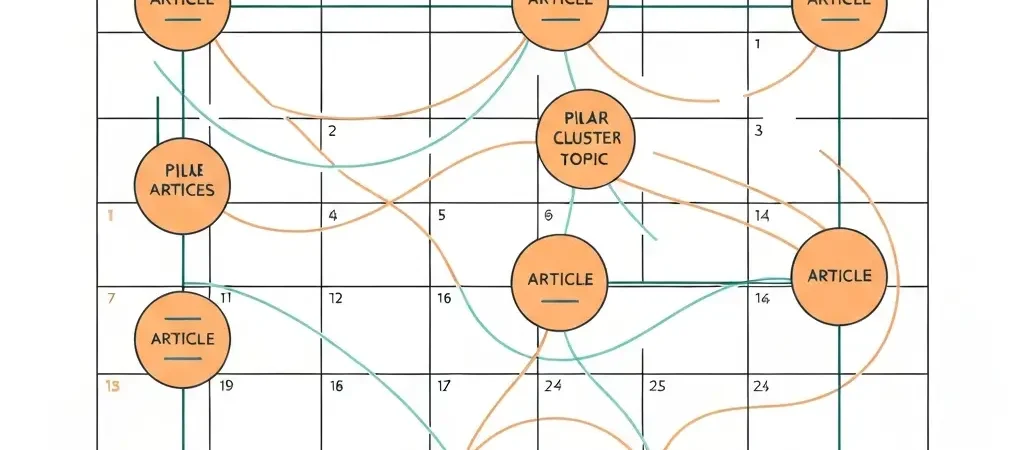
A topical authority calendar operates on three publishing layers that correspond to the content types in a pillar-cluster model:
Layer 1: Pillar Articles (20% of calendar volume)
Pillar articles define the subject domain. They are broad, comprehensive, and link to all relevant cluster articles as they are published. In the calendar, pillar articles are published first — before the cluster articles they will anchor. A domain starting a new topical area should publish its pillar article in week one, before any cluster content.
Publishing frequency: One new pillar article per topical domain per quarter. For a site covering 5 topics, this means roughly one new pillar every 3 weeks.
Layer 2: Cluster Articles (50% of calendar volume)
Cluster articles target specific subtopics within each pillar domain. They link up to the relevant pillar and across to related cluster articles. Most of a site’s keyword volume and organic traffic growth comes from cluster articles — they target the specific questions users actually ask, while the pillar handles broader definitional queries.
Publishing frequency: 3-5 cluster articles per pillar topic per month for sites in growth phase.
Layer 3: Supporting Articles (30% of calendar volume)
Supporting articles target long-tail keywords that are too narrow for a full cluster article but contribute authority signals and capture specific-intent traffic. They link to the most relevant cluster article and provide additional internal link surface area.
Publishing frequency: Supporting articles fill the gaps between cluster articles and can be published at lower word counts (1,000-1,500 words) on the same schedule.
Cadence Research: What the Data Shows
Publishing cadence is one of the most researched variables in SEO, and the findings are consistent across studies:
| Publishing Frequency | Median 90-Day Traffic Growth | Median 12-Month Growth |
|---|---|---|
| 1 article/week | +11% | +38% |
| 3-5 articles/week | +34% | +127% |
| 8+ articles/week | +67% | +312% |
Source: Authenova platform data across 500+ active sites (2026). These figures assume consistent quality thresholds across all frequency levels — increased velocity with declining quality produces negative compounding effects.
The research on content velocity vs quality balance identifies the quality floor below which increased velocity becomes counterproductive. The key finding: sites that drop average word count below 1,200 words while increasing velocity see ranking degradation within 6 months.
Content Type Mix and Ratios
The 20/50/30 pillar-cluster-supporting ratio is a starting point, not a universal prescription. The optimal ratio varies by site age, domain authority, and competitive landscape:
- New sites (DA 0-20): Weight toward supporting articles (40%) to build long-tail traffic quickly while pillar articles are being indexed and gaining authority. Recommended ratio: 15% PILLAR / 45% CLUSTER / 40% SUPPORTING.
- Growth-stage sites (DA 20-40): Standard ratio: 20% PILLAR / 50% CLUSTER / 30% SUPPORTING. Cluster articles will start ranking competitively in this authority range.
- Established sites (DA 40+): Increase pillar article share and reduce supporting articles. Ratio: 30% PILLAR / 50% CLUSTER / 20% SUPPORTING. High-authority sites benefit from comprehensive pillar content that attracts backlinks.
Within the calendar, AEO-format articles (FAQ-heavy, comparison tables, direct answer intros) should represent at least 60% of cluster output. BrightEdge research confirms that 32.5% of AI assistant citations come from comparison content, and FAQ-schema articles earn 2.8x more AI citations than narrative equivalents.
Internal Linking as Calendar Infrastructure
The most common failure mode in high-velocity content calendars is internal linking debt: publishing 50 articles that do not link to each other, then spending weeks retroactively adding links. This approach is inefficient and produces uneven link distribution.
The correct model treats internal linking as a calendar infrastructure decision, not a post-publication task:
- Define the linking rules before publishing begins. Every cluster article links to its pillar. Every supporting article links to the most relevant cluster article. Every pillar article links to all its cluster articles as they are published.
- Build backward links on each publication. When a new cluster article publishes, update the pillar article to include a link to it. This keeps pillar articles fresh (triggering recrawl) and distributes link equity correctly.
- Use automation for at-scale linking. Manual linking across a library of 100+ articles is not sustainable. The internal linking automation guide covers the tools and rules configuration for automating this at scale.
The authority-building impact of consistent internal linking is documented: pages in well-linked topical clusters rank 2.3 positions higher on average than equivalent pages in isolated architectures (Ahrefs, 2025). The SEO content calendar is the mechanism through which that linking architecture is built systematically over time.
Measurement Framework
A topical authority calendar requires a measurement framework aligned with authority-building timelines rather than individual article metrics. The relevant KPIs change over the lifecycle:
- Days 0-30: Indexation rate (what % of published articles have been indexed), crawl frequency, internal link coverage
- Days 30-90: Impression growth in Google Search Console, keyword position tracking for pillar and cluster articles
- Days 90-180: Organic traffic growth rate vs baseline, page-level click-through rates, featured snippet appearances
- 6-12 months: Domain authority trend, referring domain growth (organic backlinks to data-rich articles), revenue attribution from organic traffic
For detailed benchmarks by site age and velocity, the data in organic traffic growth benchmarks by content velocity provides a reference framework for evaluating whether your calendar is on track.
Tools and Implementation
The minimum toolset for a research-backed SEO content calendar:
- Keyword research and clustering: Ahrefs Keywords Explorer or Semrush Keyword Magic Tool for initial clustering. Authenova’s built-in strategy builder for ongoing keyword management.
- Calendar management: For manual operations: Notion, Airtable, or a Google Sheet with pillar/cluster/supporting columns and status tracking. For automated operations: Authenova’s strategy scheduler, which manages the calendar as a byproduct of strategy configuration.
- Content generation and publishing: For full automation, Authenova’s Strategy Builder handles generation, scheduling, and WordPress publishing in a single pipeline.
- Analytics: Google Search Console for organic performance data. Ahrefs Site Explorer for authority and backlink trends.
Frequently Asked Questions
What is an SEO content calendar?
An SEO content calendar is a publishing schedule that maps keyword targets, content types, and publish dates to a topical authority architecture. Unlike a general editorial calendar, an SEO content calendar explicitly tracks which pillar topics each article supports, its position in the cluster hierarchy, and its internal linking responsibilities.
How many articles should an SEO content calendar include per week?
Research shows that 5-7 articles per week produces meaningful compounding effects at the 90-day mark. Sites publishing 8+ articles per week see median organic traffic growth of 67% at 90 days versus 11% for sites publishing once per week. The minimum viable cadence for compounding effects is 3 articles per week.
Should pillar articles be published before cluster articles?
Yes. Publishing pillar articles first establishes the topical authority context that cluster articles build on. A cluster article that links to a non-existent or very new pillar receives minimal authority benefit from that link. The pillar-first sequence allows cluster articles to immediately participate in an established authority structure.
How do you measure whether an SEO content calendar is working?
In the first 30 days, track indexation rates and crawl frequency. At 30-90 days, track keyword position growth for pillar and cluster articles in Google Search Console. At 90-180 days, track organic traffic growth rate and click-through rates. At 6-12 months, track domain authority growth and organic backlink acquisition as indicators of topical authority establishment.
Can an SEO content calendar be fully automated?
Yes. Platforms like Authenova allow you to define the topical architecture, keyword clusters, content type ratios, and publishing schedule once — and then run the calendar automatically. Articles are generated, internally linked, and published to WordPress on schedule without manual intervention.