SEO Content Generation That Drives Revenue: The 2026 System
SEO content generation is not a traffic strategy. Done right, it is a revenue strategy. The distinction matters because most content teams optimize for the wrong output: they measure articles published, keywords ranking, and impressions — but not the commercial content architecture that turns organic traffic into customers. In 2026, the businesses generating serious revenue from content have built systems that connect SEO content generation directly to conversion paths, not just search rankings.
According to SEOProfy’s 2026 ROI benchmark study, the median SEO ROI across industries is 748% — $7.48 returned for every $1 invested. SaaS companies report an average 702% ROI with a 7-month break-even. These are the numbers for programs that treat SEO content generation as a full funnel system, not a top-of-funnel traffic driver. This guide shows you how to build that system.
Why SEO Content Generation Drives Revenue (The Data)
Organic search generates 44.6% of all revenue attributed to digital channels for B2B companies. SEO leads close at a 14.6% rate compared to 1.7% for outbound marketing. These are not niche statistics — they reflect the structural advantage that organic search content holds over other digital channels: intent alignment. When someone arrives at your site via a search query, they have self-identified as having a specific need. The content that matches their intent precisely is the content that converts.
The challenge for most SEO content programs is that they generate traffic without earning revenue because their content architecture is entirely top-of-funnel: informational articles that attract readers who are not yet ready to buy. A complete SEO content generation system requires all three funnel stages to be covered, with AI generation handling the volume at each stage and human strategy ensuring the commercial intent signals are correctly mapped to the generation configuration.
The best AI SEO content generators compared guide evaluates which platforms handle commercial intent content correctly — since not all AI tools produce comparison and review content with the conversion-optimization signals that bottom-funnel content requires.
The Three-Tier Content Architecture
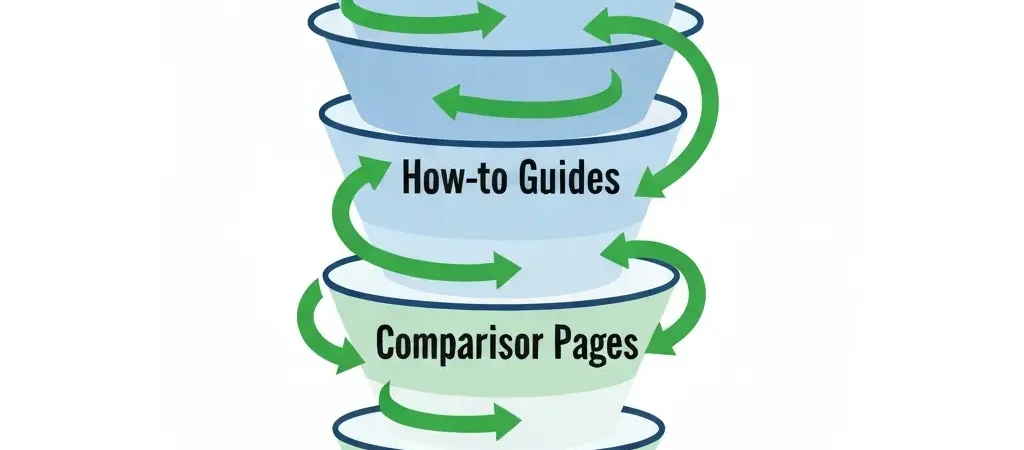
Building a revenue-generating SEO content system requires explicit planning of content across three funnel tiers, each with different keyword intent, content format, word count target, and CTA strategy.
| Tier | Intent | Content Format | Conversion Rate | % of Content Mix |
|---|---|---|---|---|
| Bottom-funnel | Commercial, transactional | Comparison, review, vs, alternative | 3–8% | 20–30% |
| Mid-funnel | Problem-aware informational | How-to, guide, best practices | 1–3% | 40–50% |
| Top-funnel | Informational, definitional | Pillar, FAQ, what-is, statistics | 0.2–0.8% | 20–30% |
The conversion rates in this table reflect performance data from content programs where commercial intent is explicitly mapped in the content architecture. Top-funnel content at 0.5% conversion is not a failure — it is volume at low direct conversion supplemented by brand touchpoint value and internal link equity flowing to bottom-funnel pages. The mistake is building only top-funnel content and expecting bottom-funnel conversion rates.
Bottom-Funnel Content: Comparison, Review, and Alternative Pages
Bottom-funnel content is the highest-value content in your SEO generation system from a direct revenue perspective. These are the pages that searchers land on when they are comparing options, looking for the best solution to a specific problem, or evaluating your product against competitors. The keywords are commercial: “best [product category],” “[product A] vs [product B],” “[competitor] alternative,” “[product] review.”
For AI-generated content in this category, the generation configuration must encode:
- Product positioning: Where your product ranks in the comparison and why, with honest pros and cons that build trust
- Feature comparison tables: Structured data that helps searchers make decisions quickly — tables are the most crawled and cited elements in comparison content
- Use-case matching: Explicit guidance on who each product is best for, which reduces bounce rates from searchers who landed on the wrong page
- Conversion CTA: A clear, low-friction next step — free trial, demo, pricing page — placed at logical decision points in the article, not just at the bottom
The content at scale guide shows how to generate comparison content at volume while maintaining the factual accuracy and product knowledge required for this content type to convert.
Mid-Funnel Content: Problem-Aware Educational Articles
Mid-funnel content targets searchers who have identified their problem but are not yet evaluating specific solutions. The keyword intent is informational but commercially adjacent: “how to [solve a problem your product addresses],” “best way to [do a thing your product helps with],” “why [problem your product solves] happens.”
This content tier works as both a traffic driver and a conversion bridge. The article teaches the reader how to solve their problem, and the solution — with evidence and context — is the product. The CTA is softer than bottom-funnel content: “See how Authenova handles this automatically” rather than “Start your free trial today.” The reader is being introduced to the product, not asked to buy it.
AI content generation handles this tier well when the strategy configuration includes: the specific problem the reader is experiencing, the product feature that addresses that problem, and the natural article flow that leads from problem education to product introduction. The AI blog writer complete guide shows how this narrative structure is configured in a generation platform.
Top-Funnel Content: Topical Authority and Traffic Volume
Top-funnel content generates the traffic volume and topical authority signals that lift your entire site’s rankings — including the bottom-funnel pages that actually convert. This is the “pillar page” and “informational cluster” content that covers your topic comprehensively: definitions, statistics, how-things-work articles, FAQ content, and AEO-optimized question-and-answer pieces.
The revenue contribution of top-funnel content is indirect but measurable: it builds the domain authority that makes your commercial pages rank higher, and it creates the first-touchpoint brand awareness that warm-market visitors carry when they eventually search for a solution. In attribution models, top-funnel content often appears as the “first click” in multi-touch conversion paths.
AI-powered generation excels at this content tier because it is structurally consistent, information-dense, and repeatable. The generation platform can produce 20 informational cluster articles per week that collectively cover a topic cluster comprehensively — building topical authority faster than any manually produced content program. This is what gives AI-powered SEO programs the compounding trajectory described in the organic traffic growth data guide.
Building the AI Generation System for Revenue Content
Building a revenue-focused SEO content generation system requires explicit configuration at the strategy layer. The generation platform needs to know more than the target keyword — it needs to know the revenue role of each article.
Configure Intent-Based Content Types
Create separate strategy configurations for each funnel tier. Bottom-funnel strategies encode product comparison positioning, competitor data, and conversion CTAs. Mid-funnel strategies encode problem-solution narrative flow and soft product introductions. Top-funnel strategies encode educational depth and AEO formatting. A single strategy configuration that tries to handle all three tiers typically produces mediocre results across all three.
Map Internal Links for Funnel Flow
Every top-funnel article should include at least one internal link to a mid-funnel article on the same topic cluster. Every mid-funnel article should link to at least one bottom-funnel comparison or review page. This creates a funnel within your content architecture: readers who enter at the top-funnel awareness stage can navigate toward commercial content through internal links, increasing the overall conversion attribution of your organic traffic.
Assign Product Placement Rules
In the strategy configuration, define explicit rules for how and where your product is mentioned: mentioned in passing for top-funnel informational content, introduced as a solution for mid-funnel how-to content, featured as the recommended option for bottom-funnel comparison content. The Authenova content generator allows you to set product placement rules at the strategy level, ensuring every article’s commercial treatment matches its funnel position automatically.
Measuring Revenue Attribution for SEO Content
Revenue attribution for SEO content requires moving beyond rank tracking and traffic metrics. The measurement framework for a revenue-focused content system includes:
- Content-attributed revenue: Revenue from sessions that include a content touchpoint in the conversion path (requires multi-touch attribution setup in GA4 or a dedicated attribution tool)
- CTA click-through rate by content tier: Bottom-funnel content should achieve 3–8% CTA CTR; mid-funnel 1–3%; top-funnel 0.5–1%. Deviations from these benchmarks indicate CTA placement or copy issues
- Content-to-trial/demo conversion rate: For SaaS, the ratio of content sessions to free trial starts or demo requests, segmented by content type and funnel tier
- Keyword-to-revenue mapping: Connecting Google Search Console keyword data to revenue events by tracking which landing pages are in the conversion path
This measurement layer is what justifies continued investment in SEO content generation at scale. When you can show that bottom-funnel comparison articles generate a 5% trial conversion rate and that each trial converts to a customer at a 25% rate, the ROI calculation of producing more comparison content becomes straightforward.
Frequently Asked Questions
How long does it take for SEO content generation to generate revenue?
For bottom-funnel commercial content targeting low-competition commercial keywords, revenue attribution can appear within 60–90 days of publication as pages reach the first page of Google. For top-funnel informational content, the revenue contribution is indirect and typically takes 6–12 months to manifest as the topical authority it builds lifts your commercial pages in rankings. Most programs see measurable content-attributed revenue within 4–6 months when the content architecture includes all three funnel tiers from the start.
What type of SEO content generates the most direct revenue?
Comparison pages (“A vs B”), best-of lists (“best [product category]”), and alternative pages (“[competitor name] alternative”) consistently generate the highest direct revenue in SEO content programs. These bottom-funnel commercial content types target high-purchase-intent searchers who are actively evaluating options. They have lower search volume than informational keywords but significantly higher conversion rates (3–8% vs 0.5–1% for informational content).
Can AI-generated content rank for commercial keywords?
Yes, when the AI generation system is configured with accurate product knowledge, genuine comparison data, and proper E-E-A-T signals. The key difference between AI-generated commercial content that ranks and content that does not is information quality: comparison tables with real feature data, honest pros and cons, accurate pricing information, and clear use-case guidance. AI systems configured with this product and competitive knowledge produce commercial content that satisfies both search intent and Google’s quality standards.
How many bottom-funnel articles should I generate versus top-funnel?
A revenue-optimized SEO content mix typically allocates 20–30% to bottom-funnel commercial content, 40–50% to mid-funnel educational content, and 20–30% to top-funnel informational and topical authority content. This ratio reflects the relationship between traffic volume (top-funnel is highest), conversion rate (bottom-funnel is highest), and funnel flow (mid-funnel bridges the two). Sites that publish 80–100% top-funnel content get high traffic but low revenue; sites that publish exclusively bottom-funnel content get lower traffic but miss the topical authority signals that make their commercial pages rank.
What is the best SEO content generation platform for revenue-focused content?
The best SEO content generation platform for revenue-focused programs is one that allows you to configure separate strategy layers for different funnel tiers, encode product knowledge and competitive positioning at the strategy level, and set different CTA logic for each content type. Authenova supports this architecture through its strategy configuration system, allowing you to run separate generation strategies for commercial comparison content, mid-funnel educational content, and top-funnel informational content — each with the correct product placement, tone, and CTA configuration for its funnel position.
Generate Content That Converts, Not Just Ranks
Authenova’s strategy configuration lets you build separate generation pipelines for bottom-funnel, mid-funnel, and top-funnel content — each with the correct commercial intent configuration, product placement rules, and CTA logic. Start generating revenue-oriented SEO content at scale today.