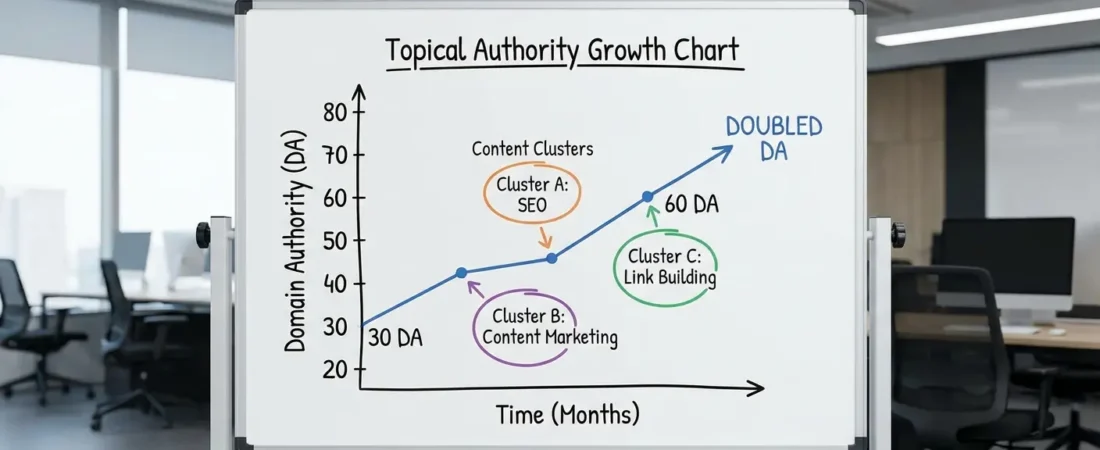
Topical Authority SEO: Double Topical Signals in 90 Days
Most SEO teams treat internal linking as an afterthought — a checkbox exercise done after publishing. That’s precisely why their topical authority SEO efforts stall after three months of content production. They’re creating the right content and publishing on the right topics, but the architecture connecting those pages is so weak that Google never consolidates the signals into a coherent expertise profile.
Here’s what the data shows: sites that implement a deliberate, bidirectional internal linking strategy — one that reinforces topical clusters from both the pillar down and the cluster up — see measurable authority gains within a single quarter. Not years. Not “eventually.” Ninety days.
This article breaks down exactly how to execute that strategy, why doubling your topical signals through internal linking works at a technical and semantic level, and what a realistic 90-day timeline looks like for teams that want to move fast without cutting corners.
What Is Double Topical Signaling in Internal Linking?
The term “double topical signaling” describes a specific internal linking pattern where topical relevance is transmitted in both directions across a content cluster — not just from parent to child pages. Most teams build one-directional hierarchies: pillar links to clusters, clusters don’t link back meaningfully. Double signaling breaks that asymmetry.
Double topical signaling is an internal linking architecture in which topical relevance flows bidirectionally — from pillar pages to cluster content and from cluster content back to related pillar and sibling cluster pages — using semantically aligned anchor text that reinforces a site’s expertise on a defined subject domain.
Koray Tuğberk Gübür, whose semantic SEO research has influenced how practitioners think about topical authority at a technical level, has explained in interviews that Google processes link signals within a topical context — not just as raw PageRank flows. The anchor text, the surrounding content, and the destination page’s topical profile all combine to form what he calls a “context vector.” When you link bidirectionally with semantically correct anchors, you’re doubling the number of context vectors pointing at your core topic cluster.
Think of it this way: a single road into a city tells traffic systems that the city exists. Multiple roads — entering and exiting in organized patterns — signal that the city is a genuine hub of activity. Google’s crawlers and language models work similarly. They’re looking for coherent webs of meaning, not isolated pages that happen to share a topic.
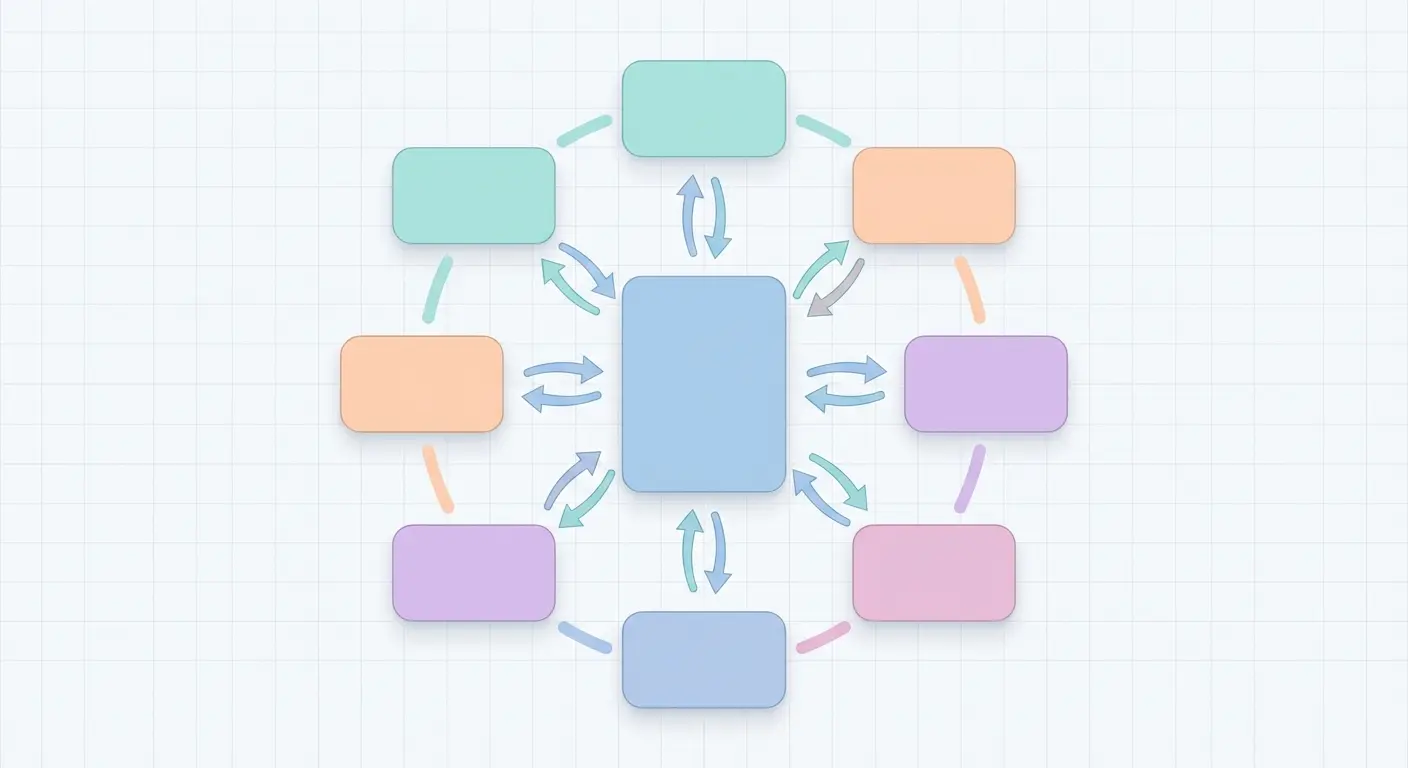
What most SEO teams miss is that cluster-to-cluster links (sibling links) are the third dimension of this model. When a cluster page on “keyword research for B2B” links to a sibling cluster on “content gap analysis for B2B,” both pages receive topical reinforcement without depending on the pillar page as an intermediary. This creates a more resilient signal web — one that doesn’t collapse if the pillar page temporarily drops in rankings.
Why Internal Links Determine Topical Authority More Than Content Alone
Publishing good content is table stakes. The question Google is actually asking is whether your domain demonstrates structured expertise — and structure is something content quality alone can’t signal.
A 2023 analysis by Ahrefs examining factors associated with appearing in AI Overviews found that topical breadth and internal link coherence were among the strongest predictors of inclusion. Pages that ranked in AI Overviews weren’t just well-written — they were embedded in tightly linked content ecosystems on domains with demonstrated subject matter depth. That’s not a coincidence.
Here’s where it gets interesting: internal links don’t just pass PageRank. According to Google’s own documentation on how crawlers process sites, internal links help Google understand the relative importance of pages within a site and the relationships between them. When those relationships map onto a coherent topic taxonomy, the site’s topical authority profile becomes machine-readable in a way that isolated keyword optimization cannot achieve.
Search Engine Journal’s coverage of how internal linking affects topical authority highlights a critical distinction: links that connect semantically related pages reinforce topical signals, while links that connect topically distant pages can dilute them. This means a site with 500 pieces of content but poor link architecture can have weaker topical authority than a site with 80 tightly interlinked, well-organized pages.
The implication is uncomfortable for teams that have been prioritizing content volume: more isn’t always better. Organized is better. And organization, in Google’s language, is expressed through internal linking patterns.
| Strategy Type | Signal Direction | Topical Coherence | Authority Build Speed |
|---|---|---|---|
| Ad-hoc linking (most sites) | Random / unstructured | Low | Slow / unpredictable |
| One-directional pillar links | Pillar → Cluster only | Medium | Moderate |
| Bidirectional pillar-cluster | Pillar ↔ Cluster | High | Fast (60–90 days) |
| Double-signal (pillar + sibling) | Pillar ↔ Cluster + Cluster ↔ Cluster | Very High | Fastest (30–60 days for initial gains) |
The Double-Signal Framework: How It Works Architecturally
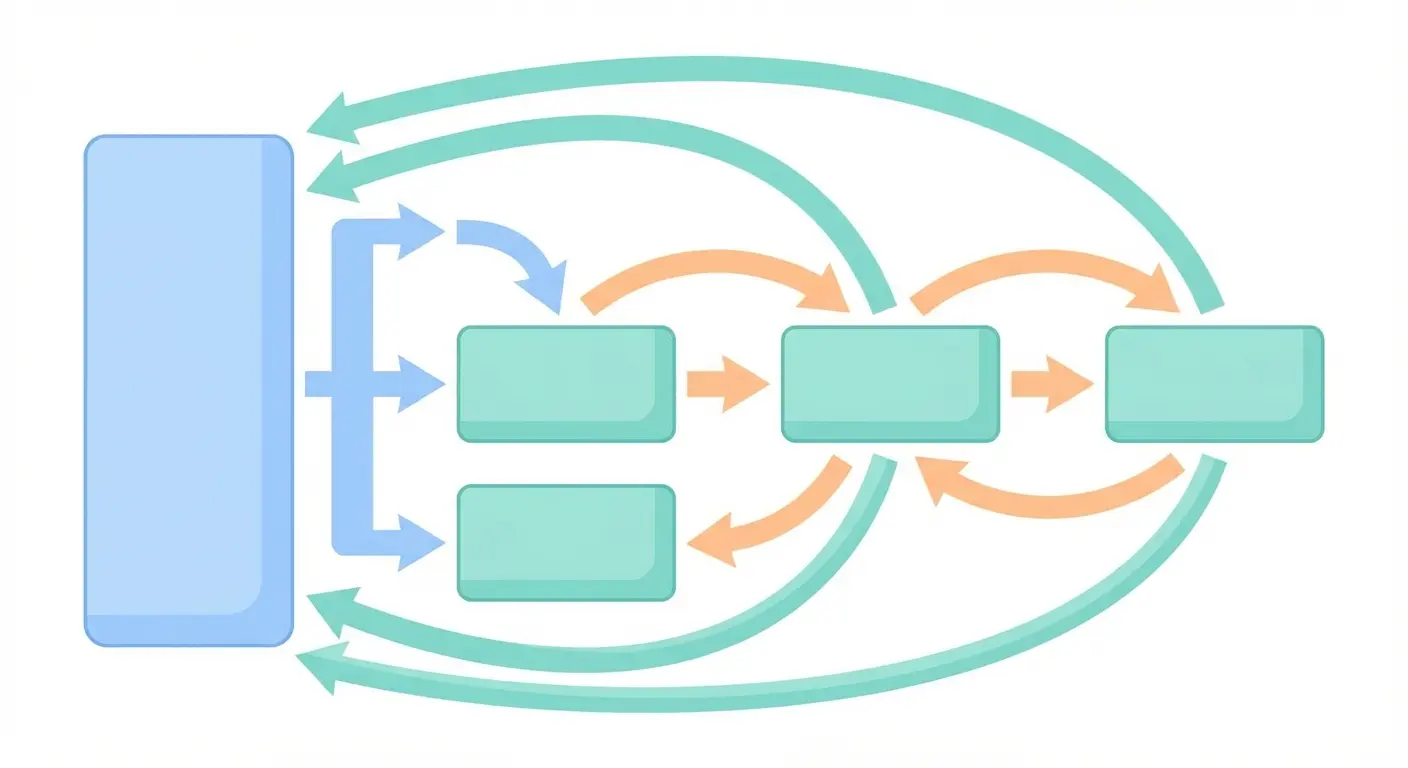
The double-signal framework operates across three linking layers, each reinforcing the others. Understanding all three is non-negotiable before you start building or auditing your internal link map.
Layer 1: Pillar-to-Cluster Links (Vertical Authority Distribution)
Your pillar page is the topical anchor — the page Google should associate with your core subject. From this page, you link to every cluster page that addresses a specific subtopic within that domain. These links should use anchor text that includes the cluster page’s target keyword, placed within contextually relevant body copy (not a generic “related articles” widget at the bottom).
The key discipline here: every outgoing link from your pillar page should make the pillar page’s coverage look more thorough, not less. If a link looks like you’re sending readers away because you can’t fully answer something, it weakens the pillar’s authority signal. If a link looks like you’re saying “here’s the deeper dive on this specific aspect,” it reinforces it.
Layer 2: Cluster-to-Pillar Links (Vertical Authority Consolidation)
Every cluster page should link back to the pillar — but not with “back to main guide” anchor text. The link back should be embedded in content, using anchor text that names the pillar’s primary topic. This is the “double” in double signaling: the pillar reinforces the cluster going down, and the cluster reinforces the pillar coming back up.
What most people miss is that the placement of cluster-to-pillar links matters as much as the anchor text. Links placed in the first or last 20% of an article carry different contextual weight than mid-article contextual links. Vary placement deliberately across your cluster pages — don’t always put the return link in the conclusion.
Layer 3: Cluster-to-Cluster Links (Horizontal Topical Mesh)
This is the layer that most sites are completely missing — and it’s arguably the highest-leverage internal linking opportunity available. When cluster pages link to each other using semantically adjacent anchors, Google builds a richer graph of your topical domain without relying exclusively on the pillar page as a hub.
Semantic SEO research — particularly the work discussed in Koray Tuğberk Gübür’s Kalicube Tuesdays sessions — suggests that Google’s knowledge graph processes co-occurrence patterns between related pages on a domain. When pages about “content gap analysis” and “keyword clustering” link to each other on a site that covers SEO strategy, Google’s entity model learns that these concepts are related within your site’s topical framework. That’s a signal that standalone keyword optimization simply cannot replicate.
For a detailed breakdown of how to architect this kind of cluster structure from the ground up, the pillar-cluster content strategy architecture guide provides a systematic model for mapping content relationships before you start building links — which is the correct order of operations.
The 90-Day Execution Plan for Topical Authority SEO
Fair warning: this takes real effort. The 90-day timeline is achievable, but only if you treat it as a structured sprint with clear weekly deliverables — not a loose “we’ll get to it” initiative.
Days 1–30: Audit, Map, and Prioritize
- Conduct a topical coverage audit. Use a tool like TopicalHQ or Semrush’s Topic Research to identify every subtopic within your core domain. Cross-reference this against your existing content inventory. Gap = opportunity.
- Build a topical map. Document every existing page, its primary topic, its secondary topics, and its current internal links (incoming and outgoing). The Yoyao Topical Map Toolkit offers a free Google Sheets template that makes this manageable for teams without enterprise tooling.
- Score existing link density. For each cluster, count how many internal links it receives (from the pillar and from siblings) and how many it sends (to the pillar and to siblings). Pages with zero incoming cluster links are “orphaned” from a topical signal perspective — flag them immediately.
- Prioritize clusters by commercial and topical value. Not all topic clusters deserve equal attention in the first 90 days. Prioritize clusters where you have existing content but weak internal linking — these are the fastest wins.
- Draft your link map. For each cluster, specify: (a) which pillar page it should link to and the exact anchor text, (b) which sibling cluster pages it should link to and their anchor text, (c) how many cluster pages should link back to it.
Days 31–60: Build, Interlink, and Fill Gaps
- Implement pillar-to-cluster links first. Update your pillar page(s) with contextual links to every cluster page. Aim for natural integration — not a bulleted list of links, but genuine in-content references that add value to the reader.
- Add cluster-to-pillar return links. Update each cluster page with a contextual link back to the pillar. Vary anchor text slightly across pages (use natural variations of the pillar’s primary keyword) to avoid over-optimization flags.
- Build sibling cluster links. For each cluster page, add links to 2–3 semantically adjacent cluster pages. This is the layer most teams skip — don’t. It’s what transforms a collection of pages into a topic mesh.
- Publish gap-filling content. If your topical audit revealed subtopics with no existing content, publish supporting articles during this phase. Use AI-assisted content production workflows — the AI-powered SEO content strategy guide for 2026 covers how to maintain quality and topical precision at scale — and immediately integrate these new pages into your link map.
Days 61–90: Measure, Refine, and Expand
- Track ranking consolidation. Look for pages that were ranking in positions 8–20 for cluster keywords and have moved to positions 1–7. This “rank consolidation” effect is typically the first measurable result of improved topical authority SEO.
- Monitor featured snippet capture. Sites with strong topical authority consistently capture more featured snippets for question-based queries in their topic clusters. Track snippet appearance rates in Google Search Console.
- Audit crawl patterns. Use Screaming Frog or a similar crawler to verify that your new link architecture is being crawled as intended. Check for crawl depth improvements — cluster pages should now be reachable in fewer clicks from the homepage.
- Expand the mesh. Based on what’s working, extend your double-signal linking pattern to secondary topic clusters. The first 90 days establish proof of concept; subsequent quarters scale it across your full content library.
Measuring Topical Signal Strength: KPIs That Actually Matter
The question every CMO asks at day 91 is: “Did it work?” The honest answer is that the wrong KPIs will make an effective strategy look like a failure, and vice versa. Here’s how to measure topical authority SEO gains with precision.
The definitive framework for topical authority SEO identifies four primary measurement dimensions: topical coverage, ranking consolidation, authority depth, and trust signal velocity. Internal linking improvements primarily affect the first two within a 90-day window.
Topical Coverage Score
Calculate the percentage of your target topic’s key subtopics for which your site has indexed, ranking content. A useful benchmark: sites considered authoritative by Google typically cover 70–85% of subtopics in their core domain. If you’re at 40% coverage, your internal linking improvements will be constrained by content gaps — both matter.
Rank Consolidation Index
Track the number of keywords for which your domain ranks in positions 1–3 versus positions 4–10 versus positions 11–30, segmented by topic cluster. A successful double-signal campaign moves keywords from the 11–30 band into the 4–10 band, then gradually consolidates 4–10 into 1–3. This progression is more predictable and measurable than watching individual keyword ranks in isolation.
Internal Link Equity Distribution
Use a tool like Ahrefs’ internal link report or Screaming Frog’s link analysis to measure how evenly internal link equity is distributed across your cluster. High variance (pillar gets 80% of links, clusters get 5% each) indicates a one-directional architecture. Post-optimization, you should see a more even distribution with clear topical groupings.
Common Mistakes That Dilute Topical Signals
Knowing what not to do is half the battle. These are the four most common internal linking errors that actively undermine topical authority SEO — and two of them are things most SEO guides actively recommend.
Over-Reliance on Navigation Menus
Navigation links and footer links are not internal links for topical authority purposes. They’re architectural links that Google understands as site structure, not topical reinforcement. Every site has them. They contribute almost nothing to cluster signal strength. The internal links that move the needle are contextual, in-body links embedded in relevant copy — the kind that a human reader might actually follow because they add value in context.
Generic Anchor Text Across All Cluster Links
Using “read more about this topic” or “see our guide” as anchor text wastes the topical signal entirely. Anchor text is one of the primary mechanisms through which link signals carry topical context. “Advanced keyword clustering for SaaS SEO” tells Google something specific. “Read more” tells Google nothing.
Linking Between Topically Distant Pages
This one surprises people. Linking between pages that share no topical relationship — even if both pages are on your domain — can dilute the topical signal of both pages. If your pillar on content strategy links to a page about website design because they happened to be published in the same month, you’re teaching Google that these topics are related on your domain. They might not be. Keep your link graph topically coherent.
Treating Internal Link Audits as One-Time Events
Topical authority SEO is not a set-and-forget system. Every new page you publish should be immediately integrated into your link map — receiving links from relevant existing pages and sending links to relevant existing pages. The sites that maintain topical authority over time treat internal linking as an editorial workflow step, not a technical SEO task done once a year.
Frequently Asked Questions
How many internal links does a cluster page need to signal topical authority effectively?
There’s no universal number, but a practical benchmark is 3–6 incoming contextual internal links per cluster page — at least one from the pillar and 2–4 from semantically adjacent cluster pages. What matters more than quantity is the topical relevance of the linking pages and the precision of the anchor text used. A single highly relevant, contextually embedded link outperforms five footer links every time.
Can internal linking alone build topical authority without new content?
Internal linking can significantly amplify existing topical authority signals, but it can’t manufacture authority that isn’t there. If your content library already covers 60–70% of a topic’s key subtopics, restructuring internal links can unlock rankings your existing pages weren’t capturing. Below that coverage threshold, you’ll need to produce gap-filling content alongside link optimization to see meaningful gains.
How does internal linking for topical authority differ from traditional PageRank-based internal linking?
Traditional PageRank-based internal linking optimizes for equity flow — sending link “juice” from high-authority pages to pages you want to rank. Topical authority internal linking optimizes for semantic coherence — creating link patterns that map your domain’s expertise structure so Google can classify your site as authoritative on a subject. The two approaches aren’t mutually exclusive, but they require different mental models and produce different types of ranking gains.
What tools are best for auditing internal links for topical authority purposes?
Screaming Frog is the most reliable tool for mapping your full internal link graph and identifying orphaned pages. Ahrefs’ internal link report helps assess equity distribution. For topical coverage mapping — identifying which subtopics have content and which are gaps — TopicalHQ and Semrush’s Keyword Gap tool are both effective. Most teams need at least two tools: one for link graph analysis and one for topical coverage assessment.
Does topical authority SEO still matter with AI Overviews changing search behavior?
Topical authority matters more with AI Overviews, not less. Ahrefs’ large-scale research into AI Overview inclusion found that topical authority signals — including internal link coherence and content depth — are among the strongest predictors of which sites get cited. AI systems need to trust a source’s expertise to cite it; topical authority is how you demonstrate that expertise at scale.
Build the Topical Authority Architecture That Rankings Demand
The double-signal internal linking model described here isn’t theoretical — it’s the same structural approach that separates sites with genuine topical authority from those that publish content and wait. If you want to go deeper on the foundational theory behind why this works at a search engine level, the definitive topical authority SEO framework provides the full research-backed model with phased implementation milestones.
For teams ready to architect the full pillar-cluster system from scratch — including content mapping, cluster prioritization, and link map templates — the pillar-cluster content strategy architecture guide is your starting point.
Share this framework with your content team. Cite it in your next strategy presentation. And if you’re implementing a 90-day topical authority sprint, document what works — the SEO community learns faster when practitioners share real results, not just theory.