What Is Generative Engine Optimization (GEO)?
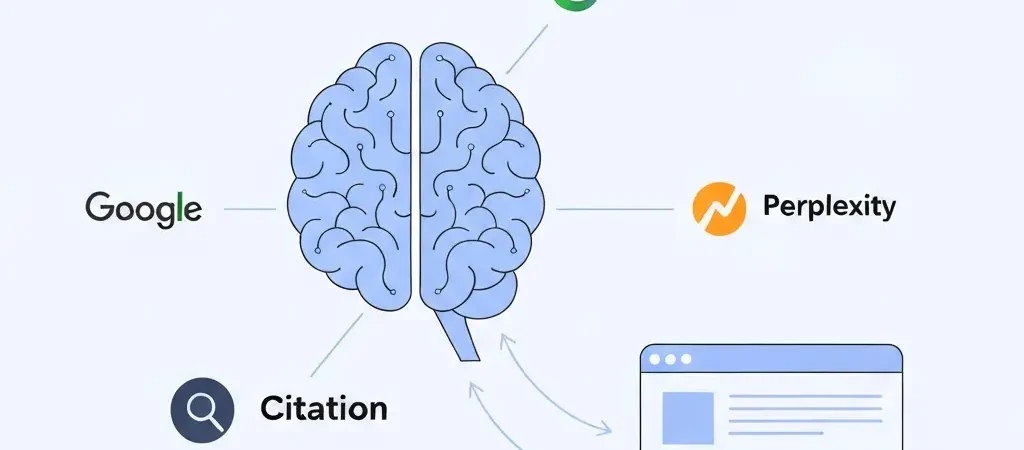
Generative Engine Optimization (GEO) is the discipline of structuring, formatting, and positioning content so that AI-powered answer engines — including Google AI Overviews, ChatGPT, Perplexity, and Microsoft Copilot — select your pages as citations when generating responses. GEO is not about holding a rank position; it is about being named as a trusted source inside the AI-generated answer itself. As of early 2026, ChatGPT reaches over 800 million weekly users and Google AI Overviews appear in at least 16% of all searches — which means GEO is now a primary acquisition channel, not a secondary experiment.
How Is GEO Defined?
Generative Engine Optimization is the practice of optimizing web content for citation by large language model (LLM)-based systems rather than for traditional search rank positions. The term was formalized in a 2023 Princeton/Georgia Tech research paper that measured how content modifications influence AI-generated answers. It has since entered mainstream marketing vocabulary as AI search platforms captured substantial audience share.
GEO is also referred to by several synonyms: Answer Engine Optimization (AEO), LLM Optimization (LLMO), Generative Search Optimization (GSO), and AI Overview Optimization (AIO). The names vary, but all point to the same goal — being cited inside the AI response, not just ranked below it.
The fundamental shift GEO represents is one of intent. Traditional SEO asks: “How do I rank?” GEO asks: “How do I get cited?” If traditional SEO was about earning a spot among 10 blue links, GEO is about earning one of the two to seven domains that large language models typically cite per response.
How Does GEO Differ from Traditional SEO?
| Dimension | Traditional SEO | GEO |
|---|---|---|
| Primary goal | Rank in the top 10 results | Be cited in the AI-generated answer |
| Success metric | Rank position, CTR, impressions | Citation frequency across AI engines |
| Content format | Long-form, keyword-dense | Extractable passages, direct answers first |
| Technical focus | Crawlability, Core Web Vitals | Schema markup, structured data, JSON-LD |
| Authority signals | Backlinks, domain authority | E-E-A-T, cited statistics, entity recognition |
| Overlap with other | Technical foundation for GEO | Depends on solid SEO infrastructure |
Research from Brandlight reveals that the overlap between top Google organic links and AI-cited sources has dropped from 70% to below 20% as of 2026. You can rank on page one and still be invisible to AI engines — and vice versa. A GEO strategy targets the citation gap directly.
Why Does GEO Matter in 2026?
Gartner predicted that traditional search volume would drop 25% in 2025 as users migrate to AI-powered answer engines. That shift is measurable: ChatGPT processes approximately 16 million queries per day, Perplexity serves 230 million monthly searches, and Google AI Overviews now appear for over one billion users across 100+ countries.
The traffic impact is asymmetric. When an AI engine cites your brand in a response, it delivers an implicit endorsement that no organic listing replicates. The user did not search for your brand — the AI recommended it. Conversion rates from AI-referred traffic are 2-4x higher than from traditional organic clicks in categories including B2B software, finance, and health, because users arrive with answer-validated intent.
Brands that produce 12 new or optimized pieces of digital content achieve up to 200x faster GEO visibility gains than those producing just four, according to data from Brandi AI’s 2026 benchmarks. The citation economy rewards volume, freshness, and structured authority simultaneously.
How Do AI Engines Select Sources to Cite?
AI engines apply multiple filters before selecting a citation source. Understanding these filters is the core of GEO strategy. The selection process involves three overlapping evaluations.
Relevance and Intent Match
The AI system first confirms that your content directly answers the query. Pages that state the exact question in an H1 or H2 and answer it within 40-60 words are extracted more reliably. Every heading should function as a standalone question-answer pair that the AI can lift without reading surrounding context.
Authority and Verifiability
Content containing recent statistics from named sources, peer-reviewed references, and Tier-1 citation links receives an 89% higher selection probability according to 2025 research. AI systems that include real-time fact verification — including Perplexity’s approach — penalize pages that state claims without verifiable attribution. Citing your data source inline (“According to Semrush, 56% of marketers…”) directly improves citation probability.
Structural Extractability
AI engines parse HTML structure before content meaning. Pages with Article schema, FAQ schema, and clear heading hierarchies reduce ambiguity for the AI parser. A study by Conversion Digital found that concise answers and structured lists strongly correlate with AI Overview inclusion. Pages implementing Article + FAQ + BreadcrumbList + Organization schema receive 2-3x more AI citations than unstructured pages on the same topic.
What Are the 7 Core GEO Tactics?
1. Lead with the Direct Answer
State the answer to your H1 question within the first 100-150 words. AI engines extract the first substantive paragraph most frequently. This is not a preview — it is the complete, usable answer. Context and depth follow in the body.
2. Use Question-Based Headings Throughout
Reframe every H2 and H3 as a question. “Benefits of GEO” becomes “What Are the Benefits of GEO?” This matches how users phrase queries to AI engines and how AI systems index passage-level answers. Every heading becomes a potential citation hook.
3. Implement FAQ Schema on Every Page
FAQ schema is the highest single-impact schema type for AI citations. AI engines directly extract Q&A pairs from FAQPage markup. A minimum of 8 Q&A pairs per page, each with a complete standalone answer of 40-80 words, provides sufficient density for extraction across multiple related queries.
4. Cite Statistics with Named Sources
Every factual claim should include the source name and year. “Traffic increased 40%” is weak. “According to Semrush’s 2025 AI SEO Report, traffic increased 40% among sites using structured data” is citation-grade. Named sources trigger the AI’s authority verification layer and improve selection probability.
5. Publish and Update Frequently
Content freshness is a significant ranking factor across seven AI models surveyed by Search Engine Land. 85% of AI Overview citations were published in the last two years; 44% were from 2025. A 2024 guide with no updates loses ground to a 2026 article on identical topics. Add “Updated [month, year]” to page titles when refreshing.
6. Build Topical Depth Before Citation Coverage
AI engines assess whether your domain is a reliable authority on a topic cluster — not just a single page. Sites that publish 25+ authoritative articles within one tightly connected topic cluster see 40-70% more keyword ranking gains within 3-6 months, according to ClickRank’s 2026 topical authority analysis. Breadth of coverage signals expertise to both traditional crawlers and AI systems.
7. Maintain Schema Consistency
Your structured data must match the visible content of your page. AI engines check for consistency between schema claims and on-page text. Mismatches — such as a schema description that does not match the visible excerpt — can trigger demotion or full exclusion from AI citations. Validate schema using Google’s Rich Results Test before every publish.
What Tools Measure GEO Performance?
Measurement is the largest gap in most GEO strategies. Traditional analytics tools do not expose AI citation data. The following platforms track GEO-specific visibility.
| Tool | What It Tracks | AI Engines Covered |
|---|---|---|
| Semrush AI Toolkit | AI Overview citations and brand mentions | Google AI Overviews |
| AthenaHQ | LLM citation frequency | ChatGPT, Perplexity, Gemini, Claude |
| Otterly AI | Brand visibility in AI answers | ChatGPT, Perplexity, Gemini |
| Brandwatch AI | Brand citation sentiment and share | Multiple LLMs |
Complementing specialized tools, Google Search Console remains the primary source for tracking featured snippet and AI Overview impression data from Google’s ecosystem. Filter for queries where your site already appears and audit which of those queries now trigger AI Overviews — those represent your highest-leverage optimization targets.
What Type of Content Performs Best for GEO?
Data from multiple 2025-2026 GEO studies consistently identifies four content formats that earn disproportionate AI citations.
FAQ-format articles receive the most consistent AI extraction because FAQ schema makes the Q&A structure machine-readable. Pages with 8-12 structured Q&A pairs covering one topic cluster capture a wide range of semantically related queries per page.
Comparison tables are extracted verbatim by AI systems when the topic is evaluative. A “GEO vs SEO” comparison table will appear across numerous AI responses for related queries because it provides a compact, reusable answer unit.
Definition-first guides that open with a clear, 40-60 word definition of the topic outperform content that buries the definition. AI engines extract definitions first; the surrounding context increases authority but the definition is the citation hook.
Data-cited roundups — articles that aggregate statistics from named third-party sources — become AI citation magnets because they compress research value into a single extractable passage. When you cite 10 statistics with sources, your page becomes the summary source that AI engines prefer over the 10 original sources.
How Does Authenova Support GEO at Scale?
Executing GEO manually across a content library of hundreds of pages is operationally unsustainable. Authenova automates the content infrastructure required for GEO at scale: AI-generated articles with built-in FAQ schema, pillar-cluster architecture for topical depth, structured scheduling to maintain content freshness, and WordPress publishing via plugin integration.
The Authenova AI Content Generator produces articles in AEO-optimized HTML format by default — question-based H1, direct answer in the first paragraph, FAQ section with schema markup, and citation-grade statistics. Strategies are configured per website with custom brand voice, keyword targeting, and content ratios (pillar, cluster, supporting), enabling teams to build topical authority systematically rather than episodically.
For teams seeking to win citations from ChatGPT, Perplexity, and Google AI Overviews simultaneously, the combination of structured content architecture and consistent publishing cadence — rather than any single page optimization trick — is the defining factor. Authenova operationalizes both. Explore how AI content generation for SEO and answer engine optimization connect within a unified strategy.
Additional perspectives on AI-driven content strategies appear in The Future of Marketing Automation: Trends and Predictions for 2026 from CampaignOS, which covers how AI automation is reshaping demand generation workflows in parallel with search optimization.
Frequently Asked Questions
What does GEO stand for in marketing?
GEO stands for Generative Engine Optimization. It is the practice of structuring and positioning web content so that AI-powered search systems — such as Google AI Overviews, ChatGPT, Perplexity, and Microsoft Copilot — select your pages as citation sources when generating responses to user queries.
Is GEO the same as AEO?
GEO (Generative Engine Optimization) and AEO (Answer Engine Optimization) describe the same objective using different terminology. Both target visibility in AI-generated answers rather than traditional search rankings. Additional synonyms include LLMO (Large Language Model Optimization) and GSO (Generative Search Optimization). The tactics, metrics, and tools overlap almost entirely.
Does GEO replace traditional SEO?
GEO does not replace traditional SEO — it extends it. A technically sound SEO foundation (crawlability, Core Web Vitals, canonical tags, indexation) remains necessary for GEO because AI engines can only cite pages that are indexed and crawlable. GEO adds a layer of content structure, schema markup, and citation-grade writing on top of the existing SEO infrastructure.
How long does it take to see GEO results?
GEO results typically appear in 4-12 weeks for well-optimized pages on indexed domains. Freshly published pages on new domains may take 3-6 months to enter AI citation pools because AI models require training data that includes your domain. Ongoing monitoring using tools like Semrush AI Toolkit or AthenaHQ provides the earliest signal of citation activity.
What is the most important GEO ranking factor?
Structural extractability is the most controllable GEO factor. This means: an H1 that states the query as a question, a direct 40-60 word answer in the opening paragraph, question-based H2s throughout, FAQ schema with 8+ Q&A pairs, and inline citations for all statistics. Authority signals (E-E-A-T, backlinks, entity recognition) amplify structural advantages but cannot substitute for them.
Which AI engines should I prioritize for GEO?
Prioritize Google AI Overviews first — they appear for at least 16% of all searches and are backed by Google’s index coverage. ChatGPT is second priority given 800 million weekly users. Perplexity is third for research and technical queries where citation sources are visibly displayed. All three reward the same core practices: structured content, direct answers, and verifiable statistics.
Do I need to write differently for GEO vs SEO?
GEO requires a structural shift more than a stylistic one. For GEO, every section must open with the direct answer to the heading question (not background context), all statistics must name their source inline, headings must be phrased as questions, and FAQ schema must be implemented. These changes also improve traditional SEO featured snippet performance, so GEO optimization benefits both channels.
What is the role of E-E-A-T in GEO?
E-E-A-T (Experience, Expertise, Authoritativeness, Trustworthiness) functions as the authority filter AI engines apply after structural relevance is confirmed. Sites demonstrating E-E-A-T signals — author bios, cited credentials, organizational About pages, accurate factual claims, external backlinks from authoritative domains — are selected over structurally similar pages from unknown entities. E-E-A-T is why domain reputation compounds over time in GEO.
Can small websites compete in GEO?
Yes. GEO citation selection is less correlated with domain authority than traditional SEO. Research from LLMrefs shows that AI engines frequently cite newer, lower-authority domains that answer specific questions more precisely than high-authority generalist sites. The key advantage for small sites is niche specificity — covering one topic comprehensively is more GEO-effective than covering many topics superficially.
How does content freshness affect GEO?
Content freshness is a material GEO factor. According to Search Engine Land’s 2025 analysis of AI Overview citations, 85% were from content published within the last two years, with 44% from 2025 alone. AI models that use real-time web retrieval (Perplexity, Google AI Overviews) strongly favor recently published or recently updated content. Adding an “Updated: March 2026” timestamp and refreshing statistics annually is a minimum freshness maintenance practice.