What Is Topical Authority in SEO and Why Does It Matter in 2026?
If you have ever published a thorough, well-researched article only to watch a thinner competitor outrank you week after week, topical authority is likely the missing variable. Topical authority is the degree to which Google and other search engines recognise your website as a comprehensive, trustworthy source on a specific subject — not just on a single keyword, but across the entire topic landscape. In 2026, as AI Overviews reshape the first page and answer engines demand verifiable expertise, understanding what topical authority is and why it matters is no longer optional for serious SEO practitioners.
This guide answers every foundational question about topical authority: what it means technically, how Google actually measures it, how it differs from domain authority, and — most importantly — how to build it systematically so your content earns featured placements, AI citations, and sustained organic rankings.
What Is Topical Authority, Exactly?
Topical authority is the search engine’s assessment of how thoroughly and reliably a website covers a specific subject domain. The concept is rooted in semantic search — Google’s shift from matching keywords to understanding entities, concepts, and the relationships between them. A site with high topical authority on, say, “email marketing automation” does not just have one strong page about the subject. It has an interconnected library of content that covers every relevant sub-topic: how automation works, platform comparisons, segmentation strategies, deliverability, GDPR compliance, and more.
The term was popularised by SEO consultant Koray Tuğcu, who described it as the measure of the “information gain” a website provides on a topic relative to competing websites. Google’s patent filings around the Reasonable Surfer Model and Panda/Helpful Content system reinforce the idea: sites that satisfy user intent more completely — across all the questions a searcher might have — earn algorithmic trust that transfers to individual page rankings.
Topical Authority vs Keyword Rankings
Traditional SEO focused on winning individual keywords. Topical authority shifts the goal to dominating an entire subject area. When you achieve genuine topical authority, new pages you publish on the topic rank faster (sometimes within days), your existing pages maintain positions more resiliently through algorithm updates, and Google frequently selects your content for AI Overviews and featured snippets.
How Google Measures Topical Authority
Google does not publish a “topical authority score,” but its systems leave clear footprints in what they reward. Based on algorithm research, patent analysis, and consistent ranking patterns, here is how the measurement appears to work:
1. Entity Coverage and Semantic Completeness
Google builds a knowledge graph of entities (people, places, concepts, products) and the relationships between them. When your site’s content covers the key entities within a topic cluster — and connects them semantically through context, not just keywords — you signal comprehensive expertise. Missing entities within a topic create “authority gaps” that allow competitors to capture traffic you should own.
2. Content Depth and Information Gain
The Helpful Content system rewards content that delivers genuine information gain beyond what is already indexed. Thin content that restates common knowledge reduces topical authority; original research, unique data, and expert-level explanations increase it. Each new piece of content you publish either adds to or dilutes your authority signal.
3. Internal Linking Coherence
How your pages link to each other tells Google which content belongs to the same topic cluster and how concepts relate. A tight internal linking strategy — where cluster articles link back to pillar pages and to each other — amplifies authority transfer across the whole cluster. Poorly interlinked content leaves PageRank stranded on isolated pages.
4. E-E-A-T Signals
Experience, Expertise, Authoritativeness, and Trustworthiness (E-E-A-T) are the human quality signals that feed into topical authority assessment. Named authors with verifiable credentials, original research citations, accurate and up-to-date information, and transparent sourcing all contribute to Google’s confidence that your site is a reliable authority — not just an SEO play.
5. Publishing Consistency and Freshness
Sites that publish regularly within a topic area signal ongoing investment and expertise. A burst of 50 articles followed by six months of silence is less effective than a consistent cadence of 8–12 high-quality pieces per month. Freshness is particularly important for fast-moving topics like AI, search algorithms, and marketing technology.
Topical Authority vs Domain Authority: Key Differences
| Dimension | Topical Authority | Domain Authority (DA) |
|---|---|---|
| Created by | Google’s algorithms (real) | Moz, Ahrefs, Semrush (proxy metrics) |
| Based on | Content depth, entity coverage, semantic coherence | Backlink quantity and quality |
| Scope | Topic-specific (you can be an authority on one subject, not others) | Site-wide aggregate score |
| How to build it | Strategic content architecture, complete topic coverage | Link building, digital PR, partnerships |
| Ranking impact | Directly influences ranking for all pages on the topic | Correlational, not directly actionable |
The critical insight: a site with DA 20 and high topical authority in a niche consistently outranks DA 60 sites with scattered content. You do not need a massive backlink profile to win with topical authority — you need depth, structure, and consistency within a defined subject area.
Why Topical Authority Matters More Than Ever in 2026
Three major developments in 2025–2026 have elevated topical authority from “nice to have” to “non-negotiable” for serious SEO results:
1. Google AI Overviews Prioritise Authoritative Sources
Google’s AI Overviews — shown for approximately 15% of queries in 2025 and expanding rapidly — overwhelmingly cite sources that demonstrate comprehensive topic coverage. Google’s internal research indicates that AI Overviews reduce clicks for informational queries by 30–50%. The sites still receiving those clicks are the authoritative ones cited in the overview itself. Without topical authority, you are invisible in this new landscape.
2. The Helpful Content System Penalises Thin Coverage
The September 2023 and March 2024 Helpful Content updates removed significant traffic from sites that covered topics shallowly or pursued too many unrelated topics. Sites with focused topical depth were consistently rewarded. In 2026, this signal is baked permanently into Google’s core ranking systems.
3. AI-Generated Content Has Commoditised Surface-Level Articles
The explosion of AI-generated content has flooded the web with adequate, generic articles. The differentiator is no longer “can you write about this topic” — it is “do you own this topic.” Topical authority, built through strategic content architecture and genuine expertise, is the moat that AI-generated commodity content cannot cross.
The Pillar-Cluster Model: Architecture of Authority
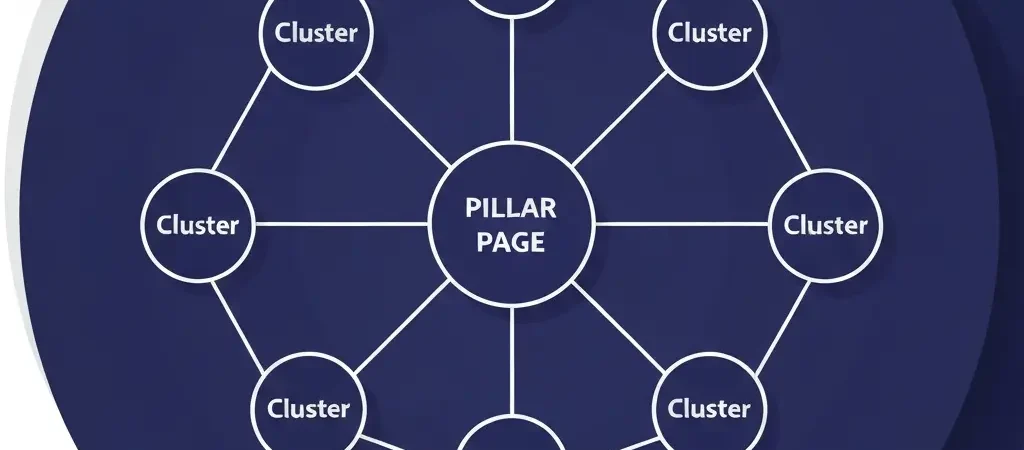
The most proven structural approach to building topical authority is the pillar-cluster model. Understanding it is essential before you write a single word. You can explore the full technical implementation in our guide to pillar-cluster content strategy with real examples.
Pillar Pages
A pillar page covers a broad topic comprehensively — typically 2,500–5,000 words. It answers all the major questions a reader might have about the subject, serves as the authoritative hub for the topic cluster, and links out to all related cluster content. This article is itself a pillar page for the topic of topical authority.
Cluster Articles
Cluster articles go deep on specific sub-topics within the pillar’s domain. They are typically 1,200–2,000 words, target long-tail keywords, and always link back to the pillar page and to two to three related clusters. The density of this interconnection is what creates the semantic signal Google reads as topical authority.
Supporting Content
Supporting articles address the most granular questions: comparison tables, how-to guides for specific tools, FAQ expansions, glossary entries. These capture long-tail traffic and signal to Google that your site leaves no question unanswered within the topic area.
Example Topical Map: SEO Content Automation
- Pillar: What Is SEO Content Automation? (Complete Guide)
- Clusters: Best AI SEO Tools, How to Automate SEO Step by Step, AI Content Generator vs Human Writer, Measuring SEO Automation ROI
- Supporting: Schema markup setup, WordPress plugin comparison, content calendar templates, SEO automation for agencies
How to Build Topical Authority Step by Step
Step 1: Define Your Topic Universe
Choose one to three core topics where you want to build authority. Narrower is better, especially early on. A site about “marketing automation” is more achievable than a site about “marketing.” Map all the sub-topics, questions, and entities within your chosen domain using tools like Semrush Topic Research, Ahrefs Content Gap, or Google’s People Also Ask and autocomplete data.
Step 2: Audit Your Existing Content
Before publishing anything new, audit what you have. Identify: (a) topics you cover well, (b) topics you cover partially or shallowly, (c) topics you have not covered at all. This gap analysis defines your publishing priority queue. A thorough keyword cannibalization and content gap audit often reveals that consolidating thin articles delivers faster authority gains than publishing new ones.
Step 3: Build Your Pillar Pages First
Your pillar pages are the load-bearing walls of your authority structure. Write them first, write them comprehensively, and optimise them for your primary topic keywords. Each pillar page should target a search volume of 1,000–10,000 monthly searches and cover the topic from beginner to advanced level.
Step 4: Execute a Consistent Cluster Publishing Cadence
Publish cluster content at a consistent pace — typically 8–16 articles per month for a growing site. Each article must: target a specific long-tail keyword, add genuine informational value not duplicated elsewhere on your site, link back to its pillar page, and cross-link to two to three other relevant cluster articles. Tools like Authenova can automate this publishing cadence without sacrificing quality.
Step 5: Optimise Internal Linking Continuously
Internal linking is the connective tissue of topical authority. As your content library grows, regularly audit your internal link structure to ensure: pillar pages receive the most internal links, new articles are immediately linked from relevant existing articles, and orphaned pages (zero internal links pointing to them) are eliminated. The complete internal linking strategy guide covers the hub-and-spoke architecture in detail.
Step 6: Build E-E-A-T Signals
Demonstrate expertise visibly: name your authors and link to their credentials, cite primary sources and original research, update articles when information changes, and include original data or case studies where possible. These signals matter more in your topic area than backlinks from unrelated domains.
Step 7: Earn Topic-Relevant Backlinks
Backlinks are still a ranking factor, but topic-relevant backlinks from sites in your niche carry disproportionate weight for topical authority. A link from a respected industry publication carries more authority signal than ten links from generic article directories. Focus your link-building on digital PR, original research publication, and expert roundup contributions within your subject area.
How to Measure Your Topical Authority Progress
Since there is no single “topical authority score,” you measure progress through a composite of signals:
- Average position for topic cluster keywords: Track the average ranking position for all keywords in your topical cluster. Improving average position across the cluster — not just for individual pages — indicates growing authority.
- Ranking velocity: How quickly do new articles on your core topic reach page one? Sites with high topical authority often see new content rank within two to four weeks rather than three to six months.
- AI Overview inclusion rate: Track how often your content appears in Google’s AI Overviews for your target keywords. Inclusion is a strong proxy for authority recognition.
- Featured snippet wins: Count your featured snippet placements for topic-related queries. These are direct indicators of Google’s authority assessment.
- Organic traffic share within topic: Compare your estimated organic traffic for a topic against the total estimated search volume. Growing share indicates growing authority.
Common Topical Authority Mistakes to Avoid
Mistake 1: Too Broad a Topic Focus
Trying to build authority on “digital marketing” from a new site is like trying to fill an ocean with a garden hose. Start with a specific sub-niche — “email marketing automation for SaaS” — build authority there, then expand. Niche authority transfers upward as you grow.
Mistake 2: Publishing Without a Topical Map
Random publishing, even on related topics, does not build topical authority. You need a deliberate topical map that covers all entities within your domain before you start executing. Publishing five articles on keyword research while ignoring technical SEO, content strategy, and link building leaves your authority structure incomplete.
Mistake 3: Ignoring Internal Linking at Publication Time
Every new article should be published with at least two to three internal links already in place — both links pointing to the new article from existing content, and links within the new article pointing to relevant existing pages. Waiting to “do internal linking later” means most articles never get properly integrated into your authority structure.
Mistake 4: Duplicating Content Within Clusters
Keyword cannibalization — where multiple articles on your site target the same keyword or cover the same sub-topic — actively damages topical authority by splitting authority signals and confusing Google about which page to rank. Maintain a strict content brief for each article that defines its unique angle within the cluster.
Mistake 5: Chasing Volume Over Depth
Publishing 100 thin articles is worse than publishing 30 genuinely comprehensive ones. The Helpful Content system penalises content that exists primarily to capture rankings rather than to serve users. Every article in your cluster should be the best resource available on its specific sub-topic.
Frequently Asked Questions
What is topical authority in SEO?
Topical authority is Google’s assessment of how comprehensively and reliably a website covers a specific subject domain. It is built through complete topic coverage, semantic content architecture (pillar-cluster model), consistent E-E-A-T signals, and coherent internal linking. Sites with high topical authority rank more easily for all keywords within their topic area, receive more AI Overview citations, and maintain rankings more resiliently through algorithm updates.
How is topical authority different from domain authority?
Domain authority (DA) is a third-party metric created by tools like Moz and Ahrefs, based primarily on backlink profiles. Topical authority is a real algorithmic signal within Google, based on content depth, entity coverage, and semantic coherence within a subject area. A site with low DA but high topical authority in a niche routinely outranks high-DA sites with broad, shallow content. The two metrics are complementary but distinct.
How long does it take to build topical authority?
For a new site in a competitive niche, building meaningful topical authority typically takes six to twelve months of consistent, high-quality publishing at a cadence of eight to sixteen articles per month. Sites in less competitive niches may see authority signals within three to four months. The timeline accelerates significantly when content is well-structured with pillar-cluster architecture, properly internally linked, and backed by genuine E-E-A-T signals.
Can you have topical authority on more than one topic?
Yes, but it requires careful management. Many successful sites have authority in two or three related topic areas. The key is to ensure each topical cluster is coherent and comprehensive within itself, and that the topics are related enough to be credible coming from the same site. A marketing automation site can plausibly build authority in email marketing, CRM strategy, and lead generation — but adding an unrelated topic like cooking recipes would dilute its authority signals.
Does topical authority help with Google AI Overviews?
Yes, significantly. Google’s AI Overviews preferentially cite sources that demonstrate comprehensive, authoritative coverage of the queried topic. Research analysing AI Overview citations consistently finds that cited sources have high topical depth and strong E-E-A-T signals. Building topical authority is currently the most reliable strategy for earning AI Overview inclusion and maintaining visibility as AI-generated summaries absorb more of the search results page.
What tools can help me build and track topical authority?
For topical map planning: Semrush Topic Research, Ahrefs Content Gap, and Google’s People Also Ask data. For content gap identification: Clearscope, Surfer SEO, or Frase. For publishing at scale: AI-powered platforms like Authenova that automate content creation within a strategic topical framework. For tracking: Google Search Console (for ranking position and click data), Ahrefs Rank Tracker (for cluster keyword tracking), and Google Analytics (for organic traffic growth by topic area).
How many articles do I need to establish topical authority?
There is no universal number, but for a typical B2B SaaS or marketing niche, a well-structured topical cluster typically requires one to three pillar pages and fifteen to forty cluster and supporting articles to establish meaningful authority. Competitive niches may require sixty to one hundred articles to cover the topic entity map comprehensively. The quality and structural coherence of these articles matters more than the raw count.
Is topical authority more important than backlinks in 2026?
For most sites and queries, yes — but the two work best together. Topical authority determines whether Google considers your site a credible source on a subject; backlinks amplify the strength of individual pages within that authoritative context. Sites with strong topical authority and moderate backlinks consistently outperform sites with strong backlinks but shallow topic coverage. In 2026, the Helpful Content system has made topical depth a prerequisite for sustained rankings, while backlinks serve as accelerants rather than foundations.
Build Topical Authority on Autopilot
Authenova generates, schedules, and publishes strategically structured content clusters — automatically. Go from topical map to full authority in months, not years.