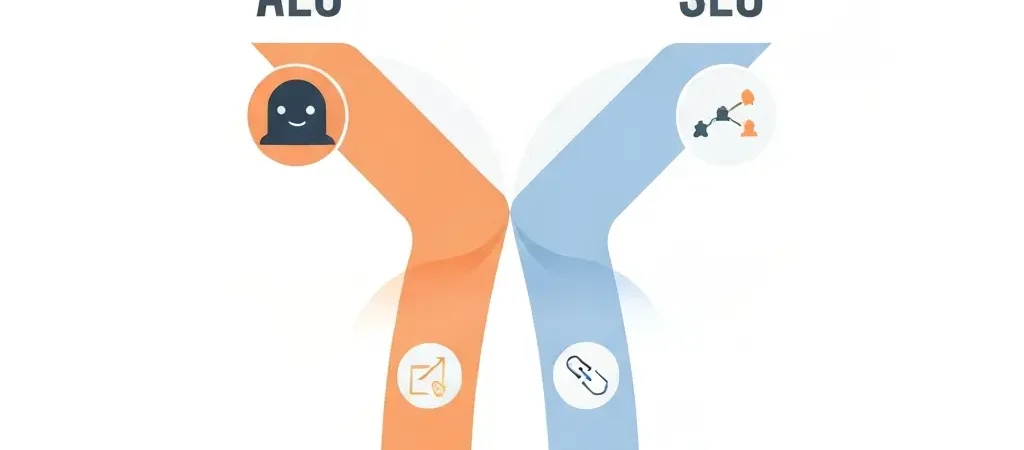
AEO vs SEO: What Is the Difference and Which Should You Prioritize in 2026?
AEO (Answer Engine Optimization) is the practice of structuring content to be cited in AI-generated answers from engines like Google AI Overviews, ChatGPT, and Perplexity. SEO (Search Engine Optimization) is the practice of improving content to rank highly in traditional search results pages. Both target organic visibility — but they optimize for fundamentally different user experiences and apply distinct content, technical, and authority strategies. In 2026, the overlap between top-ranked pages and AI-cited pages has fallen below 20%, meaning you cannot achieve one automatically by achieving the other.
How Are AEO and SEO Defined?
What is SEO?
Search Engine Optimization is the discipline of improving a website’s content, technical infrastructure, and authority profile so that search engines rank it highly for relevant queries. SEO has existed as a practice since the mid-1990s. Its primary channels are organic search results — the “ten blue links” — and increasingly featured snippets, image search, and local packs. Success is measured by rank position, organic traffic, and click-through rate.
What is AEO?
Answer Engine Optimization is the newer discipline of structuring content so that AI-powered answer engines — systems that generate synthesized responses rather than link lists — select your content as a source citation. AEO emerged as a named practice following the widespread deployment of AI Overviews in Google Search (2023-2024) and the explosive growth of ChatGPT and Perplexity as research tools. Success is measured by citation frequency across AI engines, brand mention share in AI responses, and indirect branded search volume.
How Do AEO and SEO Compare on Every Key Dimension?
| Dimension | SEO | AEO |
|---|---|---|
| Goal | Rank in traditional search results | Be cited in AI-generated answers |
| User journey | User sees link, clicks to your page | AI cites your brand inside its answer |
| Primary metric | Rank position, organic traffic, CTR | Citation frequency, AI visibility share |
| Content format | Long-form, comprehensive, keyword-rich | Direct answers first, question headings, FAQ schema |
| Technical priority | Core Web Vitals, crawlability, site speed | Structured data (JSON-LD), schema markup |
| Authority building | Backlinks, domain authority, PageRank | E-E-A-T signals, entity recognition, cited statistics |
| Keyword strategy | Target high-volume keywords, optimize density | Target question-format queries, match conversational intent |
| Measurement tools | Google Search Console, Semrush, Ahrefs | Semrush AI Toolkit, AthenaHQ, Otterly AI |
| Timeline to results | 3-12 months for new content | 4-16 weeks for existing indexed content |
Where Do AEO and SEO Overlap?
The substantial overlap between AEO and SEO is why they are complementary rather than competing strategies. Both disciplines require indexed, crawlable pages — a page blocked from Googlebot is excluded from both traditional rankings and AI citations. Both benefit from authoritative backlinks — domain authority from quality backlinks improves both rank position and AI citation priority. Both reward fresh, accurate content — freshness is a quality signal for Google rankings and a citation selection factor for AI engines.
Featured snippet optimization is the clearest overlap zone. Pages that earn featured snippets (position zero in traditional search) have a 60% probability of also appearing in Google AI Overviews, according to Semrush research. The content requirements for featured snippets — direct answers, structured formatting, accurate statistics — are identical to the AEO content requirements. Optimizing for featured snippets advances both channels simultaneously.
Where Do AEO and SEO Diverge?
The most significant divergence is in the objective content format. Traditional SEO rewards comprehensive long-form content that satisfies all user intent dimensions on a single page — often 2,000-5,000 words covering every aspect of a topic. AEO rewards extractability — the ability of a single passage to stand alone as a complete answer without requiring the surrounding article for context. A page can have strong SEO performance and weak AEO performance if its answers are woven into dense paragraphs rather than cleanly isolated under question headings.
The authority systems also diverge at the technical level. SEO authority runs primarily through PageRank — the link graph connecting pages. AEO authority runs through entity recognition — Google’s knowledge graph identifying your domain as a trusted source in a specific topic area. A new domain can achieve AEO citations faster than traditional rankings by building entity signals (Organization schema, social profiles, cited mentions) even before accumulating substantial link volume.
Measurement is the practical divergence that trips most teams. SEO has 25 years of established measurement infrastructure (Google Search Console, rank trackers). AEO measurement is newer and requires specialized tools — AthenaHQ, Otterly AI, Semrush AI Toolkit — that most organizations do not yet have integrated into standard reporting workflows.
Which Should You Prioritize in 2026?
The answer depends on your current organic position and growth objective. For sites with no existing SEO foundation, SEO infrastructure must come first — crawlability, indexation, technical health, and initial authority building. AEO on uncrawlable or unindexed pages is zero-return work.
For sites with functional SEO foundations (indexed pages, some organic traffic, no technical penalties), AEO investment delivers faster incremental visibility gains. Featured snippet and AI Overview optimization on existing ranking pages takes 4-8 weeks to show results; building new SEO authority takes months. The marginal return on AEO optimization is higher for established sites because it leverages existing technical equity.
Gartner’s 2025 prediction that traditional search volume would drop 25% by 2025 has partially materialized — AI engine queries have grown substantially but have not eliminated traditional search. Most markets see AI search representing 15-30% of informational query volume. The practical implication: maintain your SEO program, and layer AEO optimization onto every new article and every high-value existing page. Do not abandon SEO; augment it.
How Do You Write Content That Satisfies Both AEO and SEO?
The unified approach writes SEO-length articles (1,500-2,500+ words) using AEO-format structure. The article is long enough to satisfy comprehensive SEO coverage, but every section opens with a direct answer that satisfies AEO extraction requirements. This is the structure Authenova’s AEO FAQ & Answer Authority strategy produces by default.
For the H1 and introduction: The H1 is a question (AEO). The opening paragraph answers it in 40-60 words (AEO) and includes the focus keyword naturally (SEO). Both channels served in two sentences.
For body sections: Every H2 is a question (AEO). The first sentence under each H2 states the direct answer (AEO). The following 2-4 paragraphs expand with examples, data, and context (SEO). Every statistic cites a named source (both).
For the FAQ section: Include 8-12 Q&A pairs with FAQPage schema (AEO). Target long-tail question keywords users type into both traditional search and AI engines (both). Each answer is 40-80 words — complete standalone and keyword-rich simultaneously.
How Do You Measure AEO vs SEO Performance?
SEO performance is measured through Google Search Console (impressions, clicks, average position), rank tracking tools (Semrush, Ahrefs, Moz), and organic traffic in analytics. These are mature, well-understood metrics with established benchmarks.
AEO performance requires a different measurement stack. Google Search Console now segments AI Overview impressions from traditional organic impressions — filter the Search Results report by appearance type to isolate AI Overview data. For non-Google AI engines, tools like AthenaHQ track citation frequency across ChatGPT, Perplexity, Gemini, and Claude. Brand monitoring tools can additionally track unprompted brand mentions in AI-generated content at scale.
A complete 2026 organic performance dashboard includes both stacks simultaneously — traditional rank and traffic alongside AI citation frequency. Optimizing for one while ignoring the other creates a blind spot that understates or overstates true organic performance.
How Does Authenova Support Both AEO and SEO Simultaneously?
Authenova is built around the unified AEO-plus-SEO content architecture described above. The platform’s AEO FAQ & Answer Authority strategy produces articles that satisfy both channels by default: question-format H1 and headings, direct opening answers, FAQ schema with 8-12 Q&A pairs, Article schema with freshness metadata, internal linking for topical authority, and SEO-length body content with cited statistics.
The pillar-cluster content structure in Authenova directly addresses topical authority — the SEO and AEO signal that requires consistent volume across a topic cluster, not just individual page optimization. A strategy configured to publish 5 articles per week across a pillar and its clusters builds both topical depth (SEO) and entity recognition (AEO) simultaneously at a pace no manual content team can match.
For further reading on the individual disciplines: What Is Answer Engine Optimization (AEO)? covers AEO in depth; What Is AI Content Generation for SEO? covers how AI tools accelerate both strategies. For context on how AI-assisted content strategies are transforming adjacent fields, see The Future of Marketing Automation: Trends and Predictions for 2026 from CampaignOS and Best Free Marketing Automation Platforms Compared in 2026.
Frequently Asked Questions
Is AEO replacing SEO in 2026?
AEO is not replacing SEO in 2026. Both channels serve distinct but overlapping user journeys, and both require investment. Traditional search (Google organic) still drives the majority of intent-based website traffic for most sites. AI engine citations drive brand awareness and indirect traffic. The most effective 2026 strategy maintains SEO fundamentals while layering AEO content structure on top — not choosing one over the other.
What is the biggest difference between AEO and SEO content?
The biggest difference is the opening structure. SEO content often begins with an engaging introduction, background context, or problem statement before delivering the answer. AEO content delivers the direct answer in the first 40-60 words, before any context. AI systems extract the opening passage first; if the answer is buried, the page is rarely cited. This single structural change — answer first, context second — has the highest individual impact on AEO performance.
Does AEO help or hurt organic CTR?
AEO-optimized content can reduce direct CTR for queries where AI Overviews provide the complete answer without requiring a click. However, AI citations drive branded search volume increases — users who encounter your brand in an AI answer are more likely to search for it directly later. Net organic traffic impact is typically positive for brand-building, neutral-to-negative for single-query informational content that fully answers itself in the AI Overview.
Do I need different pages for AEO and SEO?
No. The unified content format — AEO structure within SEO-length articles — satisfies both channels from a single page. Creating separate AEO-only and SEO-only pages for the same topic would result in keyword cannibalization (competing pages) and is not recommended. The goal is one well-structured, comprehensive page per topic that earns both traditional rankings and AI citations simultaneously.
Which AI engines should I optimize for in addition to Google?
After Google AI Overviews, prioritize ChatGPT (800 million weekly users) and Perplexity (230 million monthly searches in 2026). Both use web retrieval for current information and cite sources explicitly, making them measurable AEO targets. Gemini and Microsoft Copilot are secondary priorities for most markets. The optimization tactics overlap by approximately 90% across all five engines, so a unified AEO strategy captures all simultaneously.
How do I know which pages to optimize for AEO first?
Start with your existing Featured Snippet pages — these have a 60% probability of also qualifying for AI Overview citations after AEO optimization. Second priority: your highest-traffic informational pages (how-to, definition, comparison content). Third priority: pages targeting question-format queries (“what is X,” “how does Y work”) where your rank is positions 2-10 — these are competitive for AI citation but not yet cited. Apply the AEO checklist to these pages in order of traffic value.
Can AEO be done without technical SEO knowledge?
Most AEO tactics are content-level and require no technical expertise: question headings, direct opening answers, FAQ sections, and inline citations. Schema markup (JSON-LD) requires some technical implementation but is well-documented and supported by WordPress plugins. The technical SEO prerequisites (crawlability, HTTPS, sitemap submission) require foundational technical knowledge but are not advanced. A content writer who understands the structural principles can execute most AEO optimization without developer support.
What is the role of topical authority in both AEO and SEO?
Topical authority — the depth and breadth of your domain’s coverage of a specific subject area — is a shared foundation for both AEO and SEO. For SEO, topical authority reduces the difficulty of ranking new articles on established topic clusters. For AEO, topical authority signals to AI engines that your domain is a reliable subject matter expert, increasing citation probability for all pages in the cluster. Sites with 25+ interconnected articles on one topic see 40-70% keyword ranking improvements within 6 months, per ClickRank’s 2026 analysis.
How does voice search relate to AEO?
Voice search and AEO share the same content optimization requirements. Voice assistants (Google Assistant, Siri, Alexa) extract answers from featured snippets and FAQ schema — the same content formats that earn AI Overview citations. Optimizing for AEO automatically optimizes for voice search because both rely on short, direct, structured answers that AI systems can read aloud or summarize without additional processing.
Is AEO worth the investment for a small business with limited resources?
Yes, particularly because the core AEO tactics (question headings, direct answers, FAQ sections) are writing-level changes that cost no additional budget. The incremental investment above standard SEO content production is approximately 20-30% more writing time per article for proper AEO structure. For small businesses, the high-priority AEO investments are: a FAQ section on every article, question-format headings throughout, and FAQPage schema implementation (available free via Rank Math or Yoast). These three changes capture 80% of AEO benefit at minimal cost.