
AI Content Generator: 2026 Guide to Scaling SEO
The AI content generator market crossed $14.8 billion in 2024 and is on track to hit $80 billion by 2030 — but most teams using these tools are barely scratching the surface of what’s possible. If you’re still treating an AI content generator as a faster way to draft blog posts, you’re missing the bigger play: a fully automated SEO publishing system that compounds organic traffic while you sleep. This guide breaks down exactly how to build that system in 2026, which tools actually deliver, and what the data says about real-world ROI.
According to Gartner, more than 80% of enterprises have now deployed generative AI in production. Yet only 19% of content marketers have updated their measurement frameworks to track AI-specific KPIs. That gap — between adoption and strategic execution — is exactly where Authenova users are winning. Non-AI blog creation has dropped from 65% to just 5% of all published content since 2023. The question is no longer whether to use an AI content generator, but which one fits your SEO stack and how to build a workflow that doesn’t create more work than it saves.
How AI Content Generators Work in 2026
Modern AI content generators are a long way from the GPT-2-era tools that produced incoherent paragraphs. Today’s platforms layer several AI systems on top of each other: a large language model (typically GPT-4o, Claude 3.5, or a proprietary fine-tuned model) for writing, NLP analysis of top-ranking competitor pages for on-page signals, and structured data extraction to inform content depth.
The best platforms in 2026 follow a four-stage pipeline:
- Keyword and SERP analysis: The tool ingests your target keyword, pulls the top 10–20 ranking pages, and identifies content gaps, common headings, and NLP terms that co-occur with high-ranking articles.
- Brief generation: An automated content brief defines word count, heading structure, target entities, and internal linking opportunities — reducing human input to a single review step.
- AI drafting: The LLM generates the full article body, calibrated to match your brand voice, include the focus keyword at the target density (typically 1–2%), and hit minimum-length thresholds for competitive SERPs.
- Publishing and indexing: The best tools push directly to WordPress (or via API), add schema markup, set canonical tags, and ping search engines — all without manual copy-paste.
What separates category leaders from commodity tools is what happens at stage four. Platforms that stop at drafting create a workflow bottleneck: someone still has to format, upload, optimize, and publish every article. That’s where per-article costs stay stubbornly high. True content automation platforms like Authenova eliminate that bottleneck entirely by connecting generation to publishing in a single pipeline.
The Real ROI Data: What Content Teams Are Seeing in 2026
The numbers are compelling — and increasingly well-documented. Here are the benchmark figures content teams reported in 2026 surveys:
- 68% of businesses using AI content generators report better marketing ROI than pre-AI content operations (Demand Sage, 2026).
- Companies using AI strategically see 22% higher ROI and 32% more conversions versus non-AI counterparts.
- SEO as a channel delivers a 748% ROI over a 7–9 month breakeven window when content velocity is high.
- 94% of marketers plan to use AI in content creation in 2026, up from 71% in 2024.
- Content velocity is the decisive variable: teams publishing 8+ articles/month see 2.3x organic traffic growth versus teams publishing 1–3/month, per Authenova’s own data benchmarks.
For a deeper look at how these trends are playing out across the industry, the 2026 AI content generation statistics roundup compiles the latest data on adoption rates, ROI benchmarks, and ranking performance across AI content programs.
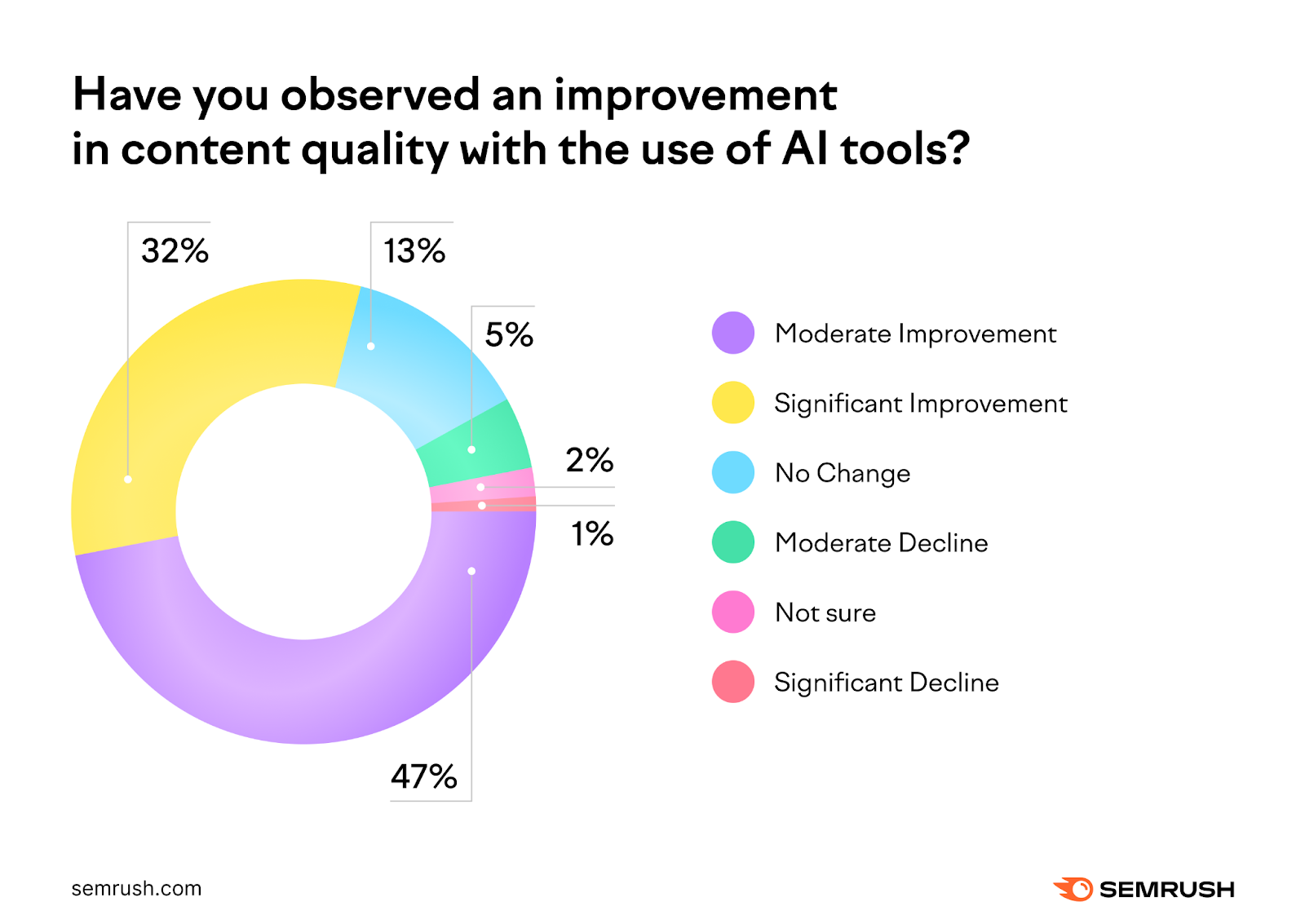
The caveat: these returns are not automatic. They accrue to teams that treat AI as infrastructure, not a shortcut. An AI content generator that produces 30 mediocre, thin articles per month will be penalized by Google’s Helpful Content system. The same tool pointed at a structured keyword strategy, with quality controls and human review gates, will compound into a durable traffic asset.
Top AI Content Generator Tools Compared (2026)
The market has consolidated around a few clear segments. Here’s how the leading tools stack up on the dimensions that matter for SEO-focused content teams:
| Tool | Primary Use Case | SEO Integration | Auto-Publish | Starting Price |
|---|---|---|---|---|
| Authenova | Full SEO content automation (strategy → publish) | Built-in keyword strategy, schema, AEO | Yes (WordPress plugin) | From $49/mo |
| Jasper AI | Brand voice content for marketing teams | Limited (no native keyword research) | No | $59/seat/mo |
| Surfer SEO | On-page content optimization | Strong NLP scoring, SERP analysis | No | $99/mo |
| Byword | Bulk AI blog generation | Moderate (SERP analysis, meta tags) | Partial (export) | $99/mo |
| Koala AI | Affordable long-form blog drafts | Basic (keyword placement) | No | $9/mo |
The critical distinction in this table is the “Auto-Publish” column. Tools that stop at drafting add a manual publishing step that easily consumes 45–60 minutes per article when you factor in formatting, image sourcing, SEO field entry, and scheduling. At 20 articles/month, that’s 15+ hours of editor time that automation eliminates. See the full comparison of Surfer, Jasper, and Authenova for a deeper feature breakdown.
SEO-Focused vs Generic AI Writers: What’s the Difference
Not all AI content generators are created for search. Generic AI writing assistants like ChatGPT, Claude, or even Jasper in its default mode are optimised for output quality — readable, coherent prose — not for organic search performance. SEO-focused AI content generators add a distinct layer: they train their prompts and outputs on SERP data, not just training corpus quality.
The practical differences matter at scale:
- Keyword placement: SEO tools hit target keyword density automatically. Generic tools need explicit prompting for every article.
- Entity coverage: Top-ranking articles for competitive keywords typically mention 40–80 semantic entities. SEO AI tools extract these from competitor pages and ensure coverage. Generic tools miss this entirely.
- Schema generation: FAQ, HowTo, and Article schema markup requires no manual input with a dedicated SEO AI platform. Learn more in our detailed tool comparison guide.
- Internal linking: SEO platforms track your existing content inventory and suggest relevant internal links as content is generated. Generic tools have no awareness of your site structure.
For teams publishing more than 4 articles per month, the gap compounds quickly. The manual overhead of adapting generic AI output for SEO outweighs the cost savings compared to a purpose-built platform.
Building a Content System That Compounds Traffic
The highest-ROI application of an AI content generator is not a one-off article — it’s a systematic publishing operation. Here’s the architecture that works in 2026:
Step 1: Build your topical map first
Before generating a single article, map your keyword universe into a pillar-cluster structure. A pillar page targets a high-volume head term (2,000+ words). Cluster pages target long-tail variants and link back to the pillar. This architecture tells Google you have deep topical authority, not just one-off answers. Our pillar-cluster content strategy guide walks through this in detail.
Step 2: Set a publishing cadence and stick to it
Consistency beats volume. Sites publishing 3–4 articles/week on a stable schedule see faster indexing than sites that publish 20 articles in a single burst then go quiet. Authenova’s scheduling system lets you define a weekly cadence per strategy and distributes content publication automatically.
Step 3: Pair AI generation with a quality gate
Every AI-generated article should pass through a one-person review gate before publishing. The review covers: factual accuracy on specific claims, brand voice alignment, and internal linking confirmation. This step takes 15–20 minutes per article and is the difference between Helpful Content compliance and thin-content penalties.
Step 4: Integrate with your distribution stack
AI content generation should feed directly into your email and social distribution workflows. If you also run email marketing automation, see the companion guide on email marketing automation strategy on CampaignOS — covering how to automatically promote new content to segmented email lists without manual campaign setup.
5 Pitfalls That Kill AI Content ROI
After auditing dozens of content operations, the same failure patterns appear repeatedly:
- Generating without a strategy: Targeting random keywords instead of a topical cluster means every article competes in isolation. Build topical depth first.
- No human review gate: Factual errors in AI output compound as you scale. A single false statistic in a high-traffic pillar can destroy credibility. Review every article before it publishes.
- Ignoring E-E-A-T signals: Google’s quality rater guidelines reward Experience, Expertise, Authoritativeness, and Trust. Add author bios, cite sources, and include first-person observations to lift these signals on AI-generated content.
- Publishing without internal links: Isolated articles — no matter how well-written — don’t pass authority efficiently. A proper internal linking and site architecture strategy is non-negotiable at scale.
- Not tracking content-level metrics: Page-level organic traffic, time-on-page, and conversion attribution should be set up before you start publishing. Only 19% of teams currently track AI content KPIs — don’t be in that majority.
How Authenova Approaches AI Content Generation
Authenova is built around the insight that the hard problem in AI content isn’t writing — it’s system design. Any AI can produce a passable blog post. What you actually need is a platform that connects keyword research, content generation, internal linking, schema markup, and WordPress publishing into a single automated loop.
Here’s what that looks like in practice:
- Strategy Builder: Define your target keywords, cluster structure, brand voice, and publishing cadence once. Authenova maps every new article to the right cluster automatically.
- AI Content Generator: Each article is generated against live SERP data for your target keyword, with NLP entity coverage, auto-generated FAQ schema, and matched internal links from your existing content inventory.
- WordPress Plugin: One-click or fully automated publishing to WordPress with featured image, SEO fields, and schema already attached. No manual formatting.
- Content Calendar: Articles publish on your defined schedule. Authenova handles queuing, scheduling, and status tracking across every strategy you run.
This end-to-end loop is what enables solo operators and small teams to consistently scale content production without a team and compound organic traffic month over month.
If you’re running performance marketing campaigns alongside SEO content, pairing Authenova with a marketing automation platform like CampaignOS creates a full-funnel loop — see their guide on what is marketing automation and how it works for context on the broader stack.
Frequently Asked Questions
What is an AI content generator?
An AI content generator is software that uses large language models (LLMs) to automatically produce written content — blog posts, landing pages, product descriptions — based on a keyword or topic input. Modern SEO-focused AI content generators also incorporate SERP analysis, NLP entity extraction, and structured data generation to optimize output for search engine ranking.
Is AI-generated content good for SEO in 2026?
Yes — when it’s produced with a clear SEO intent and passes a quality review. Google’s guidelines state that AI-generated content is acceptable as long as it demonstrates Experience, Expertise, Authoritativeness, and Trust (E-E-A-T). Thin, generic AI content without human editorial oversight still attracts Helpful Content penalties. Strategic AI content with proper optimization consistently ranks well.
How much does an AI content generator cost in 2026?
Pricing ranges from $9/month for basic AI writers (Koala AI) to $219/month for enterprise SEO platforms (Surfer SEO Scale). Full-stack automation platforms like Authenova start from $49/month and include generation, strategy, and WordPress publishing in one workflow — delivering a lower cost-per-article than tools requiring manual publishing steps.
Can AI content generators replace human writers?
For high-volume SEO content production, AI generators can replace the drafting function of human writers — but not editorial judgment, brand strategy, or subject-matter expertise. The best-performing teams in 2026 use AI to draft 80–90% of content and a human editor to review, fact-check, and add original insights before publishing.
What is the best AI content generator for SEO in 2026?
The best AI content generator for SEO depends on your workflow. Authenova leads for teams that want end-to-end automation (strategy to published WordPress post). Surfer SEO leads for on-page optimization scoring. Jasper leads for teams that prioritize brand voice and creative copy flexibility. If auto-publishing is your goal, Authenova is the only platform that handles the full pipeline natively.
How many words should an AI-generated SEO article be?
Word count should match the competitive benchmark for your target keyword, not a generic minimum. For PILLAR pages targeting head terms, 2,000–3,500 words is common. For cluster articles targeting long-tail keywords, 1,200–2,000 words often suffices. Use SERP analysis — not arbitrary rules — to set length targets. Authenova’s AI generator calibrates word count automatically based on top-ranking competitors.
Will Google penalize AI-generated content?
Google does not penalize AI-generated content per se — it penalizes low-quality, unhelpful content regardless of how it was produced. AI content that is accurate, well-structured, demonstrates real expertise, and serves user intent will rank. AI content that is thin, repetitive, or factually unreliable will be suppressed under the Helpful Content system, just like poor human-written content.
How do AI content generators handle keyword density?
SEO-focused AI content generators automatically target a 1–2% keyword density based on your focus keyword. They place the keyword in the title, H1, first paragraph, and at least one H2 heading. Generic AI writers require explicit prompting to achieve this — and still often miss natural placement. Dedicated SEO platforms like Authenova handle keyword density as part of the generation pipeline, with no manual prompting required.
What is the ROI of using an AI content generator for SEO?
Measured ROI depends on keyword competitiveness, publishing volume, and content quality. Benchmark data from 2026 shows teams using strategic AI content generation achieving 22% higher marketing ROI and 32% more conversions versus non-AI peers. SEO as a channel delivers 748% ROI over a 7–9 month breakeven when content velocity is sustained. The compounding nature of organic traffic means early investment in AI content infrastructure pays increasing returns over time.
Do I need technical skills to use an AI content generator?
No. Modern AI content generation platforms are built for non-technical users. Authenova, for example, requires only that you connect your WordPress site, define your keyword strategy, and set a publishing schedule. The AI handles generation, formatting, schema markup, and publishing automatically. No coding, API integration, or SEO expertise is required to get started.
Ready to Scale Your Content Operation?
Authenova is the AI SEO Content Automation Platform built for teams that want to publish at scale without a publishing team. Connect your WordPress site, define your keyword strategy, and let Authenova handle the rest — from AI generation to live published articles.
Start your free trial at authenova.site — no credit card required for the first 14 days.