Content Cluster Strategy: The Complete Guide to Building Topical Authority in 2026
A content cluster strategy is a structured approach to SEO where a central pillar page covers a broad topic comprehensively, and multiple cluster articles each address a specific sub-topic in depth, all internally linking back to the pillar. This architecture sends concentrated relevance signals to Google, helping the entire cluster — not just individual pages — rank for a broad swath of related queries. In 2026, with Google’s AI Overviews pulling answers from contextually rich clusters, this strategy has become the dominant architecture for sustainable organic rankings.
This guide explains how to build a content cluster from scratch: how to choose your pillar topic, map your cluster keywords, structure your internal links, and use AI tools to execute at the velocity needed to outpace competitors.
What Is a Content Cluster Strategy?
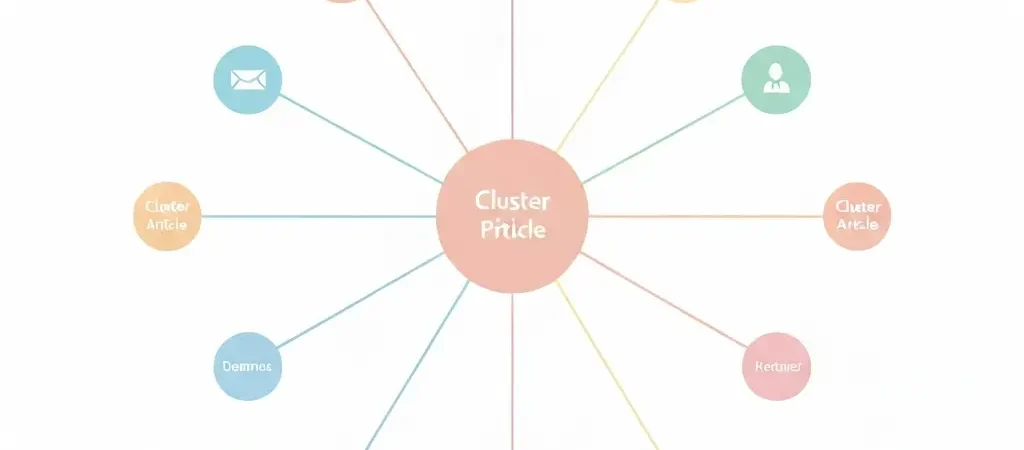
A content cluster strategy — also called a hub-and-spoke or pillar-cluster model — organises your content site into topic-focused groups rather than a flat collection of unrelated articles. Each cluster has three layers:
- Pillar page: A comprehensive, long-form guide (typically 3,000–5,000 words) on a broad topic like “SEO automation.” It targets high-volume head terms and links to every cluster article within the topic.
- Cluster articles: Focused, medium-length pieces (1,200–2,000 words) each covering one specific sub-topic: “how to automate internal linking,” “best SEO automation tools,” “SEO automation for small businesses.” Each links back to the pillar and to relevant sibling cluster articles.
- Supporting content: Short, highly specific pieces (800–1,200 words) answering narrow question queries: “what is crawl budget?” or “how often does Google recrawl pages?” These reinforce the cluster’s semantic coverage and capture voice search and featured snippet queries.
The model was popularised by HubSpot in 2017 and has since been validated by hundreds of case studies. When Google’s algorithms assess a site’s topical expertise, they look at the depth and breadth of coverage across related queries — exactly what a cluster architecture provides.
Pillar-Cluster Architecture Explained
The architecture works because of how PageRank flows through internal links. When your pillar page earns backlinks (as high-value, comprehensive guides tend to do), that authority distributes to all cluster articles through internal links. Cluster articles, in turn, each earn their own backlinks on niche sub-topics and pass that authority back to the pillar. The cluster becomes a self-reinforcing authority loop.
For marketing automation tools like CampaignOS’s open-source marketing automation guide, this architecture means a single pillar page on “marketing automation” can funnel authority to 15+ cluster articles covering workflows, deliverability, lead scoring, and segmentation — giving the entire domain ranking lift across a competitive topic landscape.
A well-executed cluster typically covers these content types:
| Content Layer | Target Keywords | Word Count | Internal Links |
|---|---|---|---|
| Pillar Page | Head terms (1,000–20,000 vol.) | 3,000–5,000 | Links out to all clusters |
| Cluster Articles | Mid-tail (200–2,000 vol.) | 1,200–2,000 | Link to pillar + 2–4 siblings |
| Supporting Content | Long-tail questions (<200 vol.) | 800–1,200 | Link to parent cluster + pillar |
How to Map Keywords to Your Cluster
Keyword mapping is the process of assigning each keyword in your topic universe to the specific article type and page that should target it. The goal is to avoid keyword cannibalization — where multiple pages compete for the same query — while ensuring every significant keyword variant is covered by exactly one page.
The process has four steps:
- Seed keyword extraction: Start with your pillar topic (e.g., “email marketing automation”) and use Ahrefs or Semrush to pull 200–500 related keywords across all intents.
- Intent classification: Sort keywords into informational (“what is email automation”), navigational (“Mailchimp features”), commercial (“best email automation tools”), and transactional (“buy email automation software”) groups.
- Cluster grouping: Group keywords by sub-topic. All keywords about “email drip campaigns” become one cluster article; all keywords about “email segmentation” become another.
- Content type assignment: Assign each group to a pillar, cluster, or supporting page based on search volume, competition, and your site’s current authority. High-volume, high-competition terms go to the pillar or main cluster articles; long-tail variants become supporting content.
Platforms like Authenova’s topical authority blueprint automate much of this mapping process — generating a complete keyword-to-page assignment plan from a single seed topic, which then feeds directly into the content generation queue.
Internal Linking Within a Cluster
Internal linking is the structural glue of a content cluster. Without it, the cluster is just a collection of unrelated pages that happen to share a topic. The linking pattern must follow specific rules to maximise authority flow:
- Every cluster article must link to the pillar page at least once with keyword-rich anchor text
- The pillar page links to every cluster article (creating the hub-and-spoke structure)
- Cluster articles link to 2–4 sibling cluster articles where contextually relevant
- Supporting articles link up to their parent cluster article and to the pillar
- All links use descriptive, natural anchor text — not generic “click here” or “read more” labels
A study published in Authenova’s internal linking strategy guide found that clusters with correct hub-and-spoke linking patterns saw 47% higher average rankings for cluster articles compared to isolated pages on the same topic. The internal linking architecture is not cosmetic — it is a core ranking factor for the entire cluster.
Academic writing platforms like Tesify.app face a similar structural challenge with their content: how to build an interconnected knowledge architecture where students move logically from foundational guides to specific technical articles. The content cluster model is the solution for any domain with a large knowledge base.
Executing Your Cluster Strategy with AI
The primary constraint on content cluster execution is production capacity. A typical cluster of 15–20 articles, each requiring 1,500–2,500 words, represents 25,000–50,000 words of content. At manual writing speed (500–800 words per hour), this is 30–100 hours of writing work — before research, editing, and publishing. Most teams cannot execute a full cluster within a competitive timeframe.
AI content generation changes this entirely. With a platform that automates drafting from keyword briefs, the same cluster can be produced in 2–4 hours of active oversight time. The AI handles structure, headers, body paragraphs, FAQ sections, and schema markup. A human editor reviews for accuracy and brand voice. Publishing automation handles the WordPress upload and scheduling.
This is the model behind Authenova’s automated SEO content creation workflow — and why teams using it consistently outpace manually-operated competitors in topical coverage speed.
How to Measure Cluster Performance
Measuring a content cluster requires moving beyond individual page rankings to cluster-level metrics:
- Cluster keyword coverage: What percentage of your target keyword universe is covered by at least one indexed page? Track this monthly.
- Pillar page ranking position: The pillar’s position for its head term reflects the overall cluster health. Improving cluster articles tends to lift the pillar.
- Total cluster impressions: The sum of Google Search Console impressions across all cluster pages reveals the topic’s total reach.
- Internal link click-through: High clicks on internal links between cluster articles indicate content is satisfying reader intent and keeping users engaged.
- Cluster backlink acquisition rate: How many new referring domains are pointing to pages within the cluster each month?
Frequently Asked Questions
How many articles should a content cluster have?
A well-performing content cluster typically contains 8–20 articles: 1 pillar page, 5–10 cluster articles, and 3–9 supporting articles. The exact number depends on the topic’s keyword universe size. Broad topics like “email marketing” may support 50+ cluster articles; narrow topics like “email subject line A/B testing” may only support 8–12.
What is the difference between a pillar page and a cluster article?
A pillar page covers a broad topic comprehensively at a high level (3,000–5,000 words) and targets high-volume head terms. A cluster article goes deep on one specific sub-topic (1,200–2,000 words) and targets mid-tail keywords within the parent topic. The pillar links to all cluster articles; each cluster article links back to the pillar.
How long does it take for a content cluster to rank?
New content clusters typically begin showing ranking movement within 60–90 days for long-tail cluster articles, and 90–180 days for competitive pillar terms. Established domains with existing authority see faster results. The key accelerator is publishing the entire cluster within a 4–6 week window rather than drip-publishing articles over many months.
Can you build multiple clusters on the same domain simultaneously?
Yes, and this is the typical strategy for authority site building. Most domains target 3–8 core topic clusters, executing them sequentially or in parallel depending on production capacity. Each cluster should be sufficiently distinct to avoid keyword overlap. The clusters can be connected through cross-cluster linking when genuinely related.
How does content cluster strategy relate to Google’s E-E-A-T signals?
Content clusters demonstrate E-E-A-T (Experience, Expertise, Authoritativeness, Trustworthiness) at the domain level. When Google sees a site covering every angle of a topic in depth — with accurate, well-cited, interlinked content — it interprets this as genuine expertise. Thin or isolated content on a topic cannot generate the same trust signals regardless of individual article quality.
Build Your Topical Authority Cluster Faster
Authenova maps your entire topic cluster from a single seed keyword, generates all pillar and cluster articles with correct internal linking, and auto-publishes to WordPress on schedule. Build the topical authority your competitors spend months building — in weeks.