How to Build a Topical Map With AI Tools Step by Step
A topical map is the content architecture that tells Google — and AI search engines — that your site is the definitive authority on a subject. Without one, even well-written articles remain isolated ranking signals. With one, every new article you publish reinforces every existing article, compounding authority across your entire keyword cluster.
Building a topical map with AI tools in 2026 is significantly faster than manual approaches — what previously took a week of keyword research and content planning can now be completed in a few hours. But the strategic thinking that makes a topical map effective cannot be automated. This guide covers both: the AI-assisted mechanics and the strategic decisions only you can make.
What Is a Topical Map and Why It Matters
A topical map is a structured content hierarchy that mirrors how search engines understand a subject area. It consists of three layers:
- Pillar pages: Comprehensive overview of the main topic (high volume, high difficulty)
- Cluster pages: Deep dives into specific subtopics that support the pillar (medium volume, medium difficulty)
- Supporting pages: Long-tail questions and specific use cases that support cluster articles (lower volume, lower difficulty)
Why topical maps work: Google’s algorithms in 2026 evaluate domain authority topically, not just by individual article quality. A site with 30 high-quality articles covering all aspects of “AI content automation” signals stronger expertise than a site with 3 exceptional articles and nothing else. The topical map ensures your content covers enough of the topic graph that Google recognizes your site as an authority — not just a publisher.
Research from 2026 indicates that fully mapped seed topics (15–30 unique articles per topic cluster) are 4.2× more likely to achieve and maintain top-3 positions compared to sites with isolated topic coverage.
Step 1: Identify Your Core Seed Topic
The seed topic is the central concept your entire topical map will branch from. It should be:
- Specific enough to own: “Marketing” is too broad; “AI SEO content automation” is appropriate
- Aligned with your business goal: The seed topic should generate traffic that converts — not just traffic
- Large enough to support 15–30 articles: Test this by searching the topic in Semrush and filtering for keywords with 200+ monthly searches
- Within reach of your domain’s current authority: New domains should target seeds with lower average keyword difficulty (under 40)
For most businesses, 1–3 seed topics is the right number to start. Spreading across too many seeds prevents achieving critical mass in any of them — and topical authority requires density, not diversity.
Step 2: Use AI to Generate Your Full Keyword Cluster
Once you have a seed topic, AI tools dramatically accelerate the keyword cluster generation phase. There are two effective approaches:
Approach A: AI Prompt-Based Generation
Ask ChatGPT or Claude: “Generate a comprehensive topical map for the seed topic ‘[your topic]’. Include: 3–5 pillar keywords, 15–20 cluster keywords organized by subtopic, and 20–30 long-tail supporting keywords. Group by search intent (informational, commercial, how-to) and indicate suggested content format for each.”
This produces a first-draft topical map in under 2 minutes. Validate keywords against real search volume data (Semrush or Ahrefs) before finalizing.
Approach B: Dedicated Topical Map Tools
Tools like Topical Map AI, Search Atlas, and Authenova’s Strategy Builder generate topical maps from seed inputs with real keyword volume data included. These produce more accurate results than pure AI prompting because they’re validated against live search data rather than training data.
Step 3: Map Keywords to Pillar and Cluster Pages
Take your keyword list and assign each to a position in the content hierarchy:
| Content Level | Volume Range | Difficulty Range | Typical Word Count | Links To |
|---|---|---|---|---|
| Pillar page | 2,000–20,000+ | 40–80 | 3,000–5,000 | All cluster pages |
| Cluster page | 500–5,000 | 20–55 | 1,500–2,500 | Pillar + related clusters |
| Supporting page | 50–1,000 | 5–30 | 1,000–1,800 | Relevant cluster page |
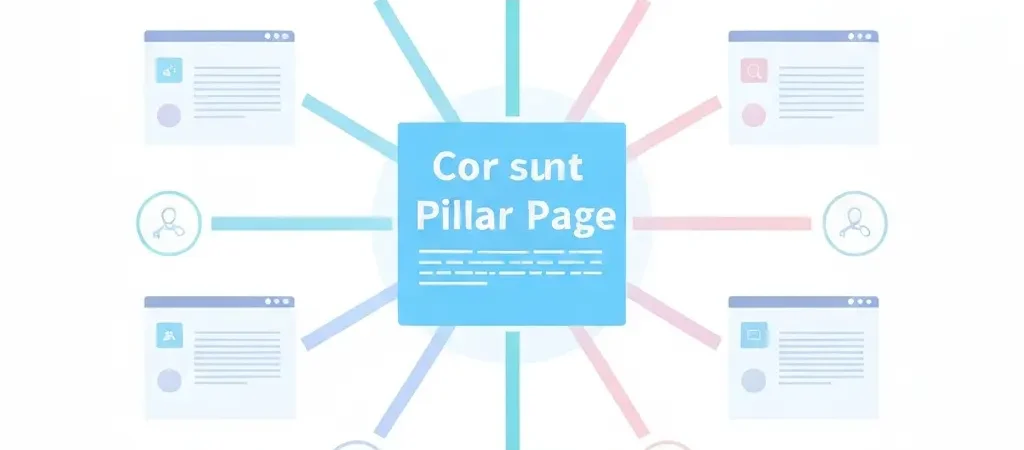
The pillar page is the hub. Every cluster page links to it. Every supporting page links to the most relevant cluster page. The pillar page links out to all cluster pages. This creates the internal link equity flow that signals topical authority to Google’s algorithms.
Step 4: Assign Intent and Content Format
Every keyword in your topical map needs an assigned intent and matching format before you write anything. Verify intent by checking the SERP for each keyword — the dominant format in the top results is the format you need to match.
Common intent-format pairings in AI/SEO content:
- “What is [topic]” → Definitional article with examples (informational)
- “Best [tools/platforms]” → Comparison listicle with feature tables (commercial)
- “How to [accomplish goal]” → Step-by-step guide with numbered steps (how-to)
- “[Topic] statistics” → Data roundup with tables and citations (informational)
- “[Tool A] vs [Tool B]” → Head-to-head comparison (commercial)
Step 5: Map Internal Linking Logic
Before publishing anything, document your internal linking plan. Every article should have pre-defined links it will send (outgoing) and pre-defined anchors it will receive (incoming).
Internal linking rules for topical maps:
- Every cluster article links to its pillar with the pillar keyword as anchor text
- Every supporting article links to its parent cluster article
- Cluster articles link to 2–4 related cluster articles within the same topic
- The pillar article has at least one link to every cluster article
- No orphaned articles (every page receives at least one internal link from day one)
Platforms like Authenova’s AI Content Generator automatically generates internal links based on your published article library — eliminating the manual work of tracking which articles to link to in each new piece.
Step 6: Execute and Audit for Gaps
Start publishing from the pillar outward. Publish the pillar first (even as a shorter version initially), then the top-priority cluster articles, then supporting articles. This order matters — Google can’t fully evaluate topical authority until the hub (pillar) exists to link to.
Every 60–90 days, audit the topical map for:
- Coverage gaps: Subtopics in your cluster that have no published article
- Linking gaps: Articles that don’t link to the pillar or relevant clusters
- Intent mismatches: Articles ranking poorly because they mismatched the SERP format
- Freshness gaps: Pillar and high-traffic cluster articles not updated in 6+ months
See also: how to build topical authority with AI content and how to create a pillar cluster content strategy for complementary guides. External context from audience segmentation in marketing automation applies directly to defining targeted topical maps.
AI Tools for Topical Mapping
| Tool | Function | Real Search Data | Best For |
|---|---|---|---|
| Authenova Strategy Builder | Map + publish automation | Yes | Full pipeline |
| Topical Map AI | Map generation | Yes | Fast map creation |
| Search Atlas | Cluster generation | Yes | Large-scale maps |
| ChatGPT / Claude | First-draft clusters | No (validate separately) | Free starting point |
| Semrush Keyword Magic | Keyword research | Yes | Volume validation |
FAQ
How do you build a topical map with AI tools?
Build a topical map with AI tools by following 6 steps: (1) identify your seed topic — specific enough to own, large enough to support 15–30 articles, (2) use AI to generate a full keyword cluster covering all subtopics and intents, (3) map keywords to pillar (broad) and cluster (specific) page levels, (4) assign search intent and content format to each keyword, (5) document internal linking logic before writing, (6) publish pillar-first and audit for coverage gaps every 60–90 days.
What is a topical map in SEO?
A topical map in SEO is a structured content hierarchy that establishes your site’s authority on a specific subject. It consists of pillar pages (comprehensive overviews of the main topic), cluster pages (deep dives into specific subtopics), and supporting pages (long-tail specific questions). Internal links flow up the hierarchy, with cluster pages linking to the pillar and supporting pages linking to cluster pages — signaling topical depth and expertise to search engines.
How many articles do you need for topical authority?
Research indicates that most revenue-driving seed topics require 15–30 unique articles to achieve recognized topical authority in Google’s algorithms. Full authority typically develops over 3–6 months of consistent publishing. Sites with 30+ topically focused, interlinked articles are 4.2× more likely to achieve and maintain top-3 positions compared to sites with isolated coverage of the same topics.
Can AI create a topical map automatically?
AI can generate a first-draft topical map in minutes from a seed topic prompt. Tools like Topical Map AI, Search Atlas, and ChatGPT can suggest keyword clusters, content hierarchies, and article titles. However, strategic decisions — which seed topics align with your business goals, which difficulty tiers match your domain authority, which content formats match your audience — require human judgment. AI accelerates the mechanics; strategy remains human.
What is the difference between a topical map and a content calendar?
A topical map is the strategic architecture — which articles to create and how they relate to each other. A content calendar is the execution schedule — when to publish each article. The topical map comes first; the content calendar implements it over time. AI tools like Authenova bridge both: the Strategy Builder defines the topical map structure, and the publishing scheduler executes it as an automated content calendar.