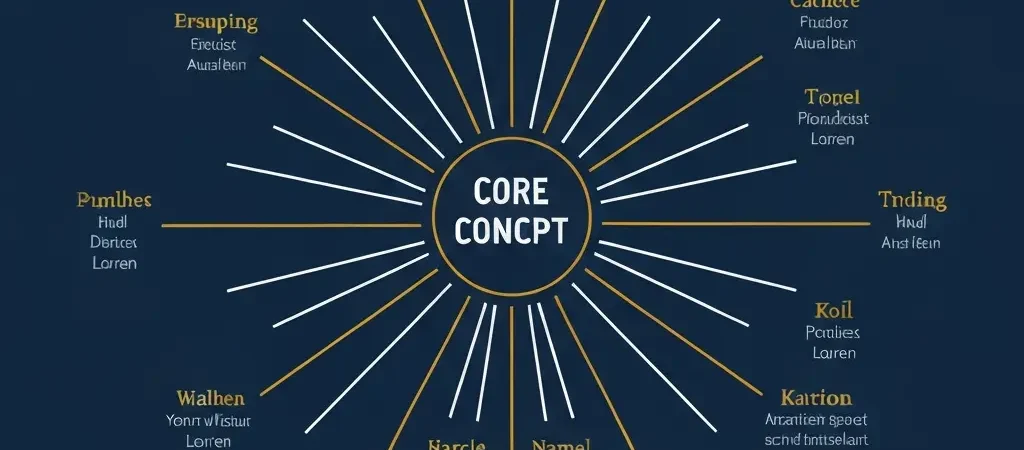
Topical Map SEO: How to Build a Complete Topic Coverage Plan in 2026
A topical map SEO strategy is the difference between content that accumulates authority and content that accumulates word count. Random articles across disconnected subtopics don’t build topical authority — even if each individual article is excellent. Google needs to see comprehensive, connected coverage of a topic domain before it classifies your site as the authority. A topical map is the blueprint that ensures every article you publish contributes to that classification.
Koray Tugcu, whose work on topical authority and semantic SEO has been cited extensively in the industry, describes a topical map as defining “the source of topical authority” — the complete inventory of what your site needs to cover to be considered the authoritative resource by Google. This guide operationalizes that concept with a step-by-step framework.
What a Topical Map Is (and What It Isn’t)
A topical map is not just a keyword list. It’s a structured representation of knowledge in your domain — all the concepts, questions, tools, processes, and entities that constitute the topic space your site aims to own.
Think of your topical map as the index of a comprehensive textbook on your topic. Every chapter (pillar), every section (cluster), and every subsection (supporting article) should appear in your map. If a concept is in the textbook but not in your map, you have a topical authority gap that Google can detect.
What Makes a Complete Topical Map
- All major concepts in your topic domain (entities)
- All question-based queries your audience searches
- All comparison and evaluation queries (“X vs Y”)
- All tool and platform mentions relevant to your topic
- All process/how-to searches your audience makes
- Historical context and foundational knowledge topics
Building Your Topical Map: Step-by-Step
Step 1: Define Your Topical Domain Boundary
Determine what’s inside and outside your topical domain. This is a strategic decision. “Content marketing” as a domain is very wide — it could encompass SEO, social media, email marketing, video, podcasting, PR, and more. Start with a narrower definition you can cover comprehensively in 6-12 months, then expand boundaries as authority establishes.
Step 2: Entity Extraction
Entities are the nouns in your topical domain — the things, concepts, people, tools, and processes Google associates with your topic. Extract them from:
- Wikipedia: Your topic’s Wikipedia page contains the canonical entity list for Google’s knowledge graph
- Google’s “People Also Ask” and “Related Searches”: These reveal the questions and associated topics Google clusters with your primary keyword
- Top-ranking articles: What entities do the top 10 articles for your primary keyword consistently mention?
- Ahrefs Topic Explorer: Reveals related keywords and topic clusters around any seed keyword
- Google Search Console: If you have an existing site, what queries already bring traffic? These reveal entities already associated with your domain.
Step 3: Organize Entities Into Hierarchical Tiers
Sort your extracted entities into three tiers:
- Core entities (PILLAR level): The 5-10 most fundamental concepts that define your topic domain. A comprehensive guide on each is mandatory for authority.
- Secondary entities (CLUSTER level): 20-50 important but more specific concepts within each core entity’s domain. Each needs its own dedicated article.
- Tertiary entities (SUPPORTING level): 50-200+ specific questions, processes, tool comparisons, and niche queries. These are your long-tail content targets.
Step 4: Map Keywords to Entities
For each entity, identify the primary keyword and 2-5 related keywords. This converts your semantic map into a production-ready content plan. Use tools like Ahrefs, Semrush, or even Google Keyword Planner for volume and difficulty data.
Step 5: Identify Coverage Gaps
Compare your entity list to your existing content. Any entity without an article is a gap. Prioritize gaps in:
- PILLAR-level entities (highest authority impact)
- High-volume keyword entities (highest traffic potential)
- Entities your competitors rank for but you don’t (competitive gaps)
Topical Map Template
Here’s the structure for a topical map in a content marketing niche:
TOPICAL DOMAIN: SEO Content Strategy

CORE ENTITY 1: Topical Authority
├── CLUSTER: How to build topical authority
├── CLUSTER: Topical map SEO
├── CLUSTER: Entity SEO
├── CLUSTER: Semantic SEO
└── SUPPORTING: What is topical authority, topical authority vs DA, topical authority examples...

CORE ENTITY 2: Content Architecture
├── CLUSTER: Pillar cluster strategy
├── CLUSTER: Content silo structure
├── CLUSTER: Internal linking strategy
├── CLUSTER: Cornerstone content
└── SUPPORTING: Pillar page examples, cluster content examples...

CORE ENTITY 3: Keyword Research
├── CLUSTER: Long tail keyword strategy
├── CLUSTER: Keyword clustering
├── CLUSTER: Semantic keyword research
└── SUPPORTING: Keyword difficulty, search intent, keyword tools...
Scaling Your Topical Map Execution
A complete topical map for a moderate-difficulty niche typically contains 150-400 content items. Executing this manually takes 2-4 years at 3-5 articles/week. AI-powered content platforms like Authenova reduce this to 3-9 months at 10-20 articles/week, while maintaining the structured architecture the topical map defines.
The topical authority SEO framework explains how this speed advantage translates to faster authority accumulation. Sites using Authenova for topical map execution — like Tesify in the academic writing space — complete full topical maps within 6-12 months, compared to 3-5 years for manual publishing at typical speeds. The French platform (tesify.fr) demonstrates this: a comprehensive academic writing topical map covered systematically through automated content production. Marketing agencies use CampaignOS alongside Authenova to manage topical map execution across multiple client campaigns simultaneously.
Frequently Asked Questions
How is a topical map different from a keyword list?
A keyword list is a collection of search terms to target. A topical map is a structured knowledge inventory organized around semantic relationships — showing how concepts relate to each other and where each piece of content fits in the broader topic domain. A keyword list tells you what to rank for; a topical map tells you how to organize your content so Google understands your expertise comprehensively rather than as isolated keyword matches.
What tools help build a topical map for SEO?
Key tools: (1) Ahrefs Topic Explorer — clusters related keywords around any seed; (2) Google’s People Also Ask and Related Searches — free entity extraction from real SERP data; (3) SEMrush Topic Research — identifies subtopics and questions; (4) Wikipedia — canonical entity lists for Google’s knowledge graph; (5) chatGPT or Claude — generating comprehensive entity lists from a topic description. Combine 2-3 of these for maximum coverage.
How often should I update my topical map?
Review your topical map quarterly. Add new entities as your niche evolves (new tools emerge, new concepts become relevant, industry terminology shifts). Mark covered entities as published and track gaps. In fast-moving niches (AI, crypto, fintech), monthly reviews may be warranted as new entities enter the topical space rapidly. In stable niches, quarterly reviews are sufficient.