How to Build Topical Authority with AI Content (2026 Playbook)
If you want to know how to build topical authority with AI content, the answer is a system, not a single article. Google’s Helpful Content era rewards sites that cover a subject comprehensively and consistently — not sites that publish one strong piece and stop. AI content tools have changed the economics: what once required a team of 10 writers for six months can now be executed by one person in six weeks, if the workflow is correct.
This guide gives you that workflow: a 10-step playbook covering every stage from seed keyword selection through to measuring real authority gains. Each step is self-contained and actionable today.
Prerequisites, Time and Difficulty
| Item | Detail |
|---|---|
| Time to complete | 3-4 hours of setup; ongoing 30 min/week |
| Difficulty | Intermediate (no coding required) |
| Tools needed | AI content platform, keyword research tool, WordPress or any CMS |
| Prerequisites | Active website, basic understanding of SEO concepts, a defined niche |
| Expected results | Measurable ranking gains in 8-12 weeks; category authority in 4-6 months |
Step 1: Choose Your Seed Keyword
Your seed keyword is the highest-level term that defines your content cluster. It should be broad enough to branch into 15-30 subtopics, but specific enough to indicate a single subject domain.
- Identify the one core topic your site wants to own (e.g., “email marketing automation”).
- Verify it has at least 1,000 monthly searches — volume confirms audience size.
- Check that the keyword difficulty is achievable for your current domain (start below 40 KD).
- Confirm there are commercial, informational, and navigational sub-queries under it — you need content variety.
Avoid: Choosing a seed keyword so broad it spans multiple unrelated topics. “Marketing” is a universe; “AI email marketing” is a cluster.
Step 2: Map Your Topic Universe
A topic universe is the complete set of questions, subtopics, and angles a fully authoritative site would cover. Mapping it before writing a single word prevents gaps and duplication.
- Enter your seed keyword into a keyword research tool and export all related terms.
- Group terms by intent: informational (“what is…”), procedural (“how to…”), comparative (“X vs Y”), and commercial (“best X for…”).
- Identify 3-5 pillar themes within the universe — these become your pillar articles.
- Under each pillar, list 6-12 specific subtopics — these become cluster articles.
- Note any supporting terms (definitions, data questions, examples) — these become supporting articles.
A well-mapped topic universe for a mid-size niche typically contains 40-80 distinct articles. You do not need to write all of them immediately — the map is your roadmap, not a sprint backlog.
For a deeper look at this architecture, see What Is Topical Authority in SEO and Pillar Cluster Content Strategy: Step-by-Step Implementation Guide.
Step 3: Outline Your Pillar Article
The pillar article is the authoritative anchor for its cluster. It must cover the topic broadly and link out to every cluster article in that theme.
- Write a working title that targets the highest-volume, broadest keyword in the theme.
- Structure the outline with one H2 per major subtopic — each H2 should correspond to a cluster article you plan to write.
- Keep each H2 section at 150-250 words: thorough enough to be useful, shallow enough to send readers deeper via cluster links.
- Add placeholder anchor text for each internal link you will add once cluster articles are live.
- Target 2,000-3,500 words for the pillar — enough breadth without padding.
Step 4: Build Your Cluster Plan
A cluster plan assigns a specific target keyword, content type, word count, and publish date to every cluster article in your theme. Without a plan, AI generation produces random content; with it, you build a coherent topical map.
- List all cluster articles identified in Step 2 for this pillar theme.
- Assign each a primary keyword, content type (how-to, comparison, FAQ, data), and target word count (1,200-1,800 words per cluster article).
- Sort them by search volume, highest first — publish the highest-value pieces early to start earning impressions while the cluster builds.
- Assign publish dates at your target cadence (see Step 8).
- Flag any articles that require unique data or expert quotes — those need human input before AI drafting.
Step 5: Create an Internal-Link Map
Internal links are the structural signal that tells Google which articles belong to the same topic cluster. A deliberate link map prevents orphan pages and distributes link equity efficiently.
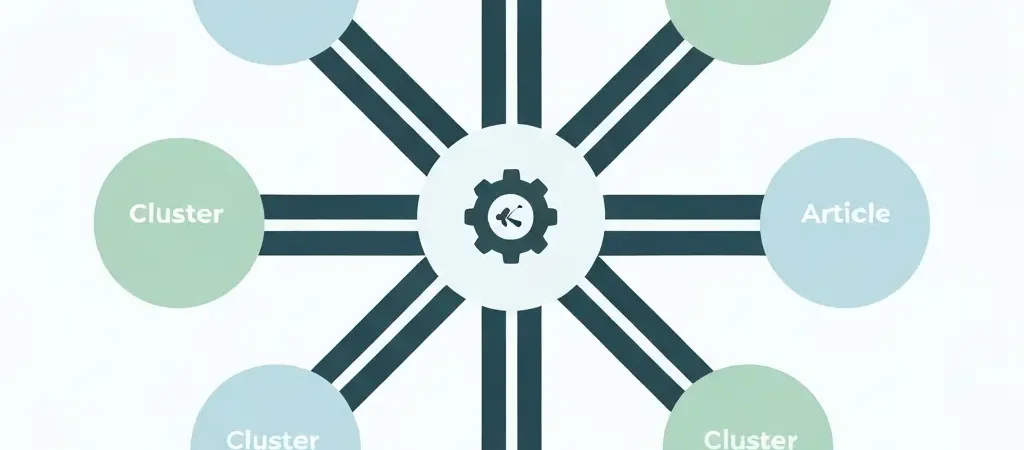
- Map a hub-and-spoke structure: pillar article links to all cluster articles; each cluster article links back to the pillar.
- Add sibling links: cluster articles on related subtopics should link to each other where contextually relevant (1-2 per article).
- Identify anchor text for each link — use the target keyword of the destination page as anchor text.
- Document the map in a spreadsheet with columns: source URL, destination URL, anchor text, placement (intro / body / conclusion).
- Revisit the map each time you add a new article — every new piece should link to and receive links from at least two existing articles.
For a comprehensive treatment of this topic, see Internal Linking Strategy for Authority Building: The 2026 Advanced Playbook.
Step 6: Generate Content with AI
With your cluster plan and internal-link map in place, AI generation becomes a structured execution task rather than a creative freeform process.
- Configure your AI content platform with your brand voice, target audience, and keyword list for this cluster.
- Generate the pillar article first — it sets the thematic context that cluster articles will reference.
- Generate cluster articles in order of publish priority, feeding the platform your outline and target keyword for each.
- Include internal link placeholders in your generation prompt so the AI drafts anchor text in the correct positions.
- Generate supporting articles last — they fill definition gaps and capture long-tail queries.
For the full generation workflow, see How to Automate SEO Content Creation Step by Step and What Is AI Content Generation for SEO.
Step 7: Run the Human Review Pass
AI-generated content requires a focused quality pass before publishing. The goal is not to rewrite — it is to verify accuracy, add original insight, and ensure E-E-A-T signals are present.
- Fact-check statistics and claims. AI models can hallucinate data points. Verify every number against a primary source.
- Add one original observation per article. A first-hand example, a proprietary data point, or a contrarian view that the AI could not have generated — this is your differentiation signal.
- Confirm internal links resolve correctly. Check that every anchor text points to the right destination URL.
- Review the introduction. The first 100 words determine whether the reader continues. Tighten if needed.
- Check keyword density. Aim for 1-2% — the focus keyword should appear naturally without forced repetition.
A quality pass on a 1,500-word cluster article takes 15-20 minutes when the AI draft is structurally sound.
Step 8: Set Your Publish Cadence
Publish cadence directly affects how quickly Google recognizes topical authority. Irregular publishing prevents the pattern recognition that rewards consistent topic coverage.
- Minimum viable cadence: 3 articles per week on the same topic cluster. Below this, crawl frequency stays low.
- Accelerated cadence: 5-7 articles per week to build a cluster in 4-6 weeks. Feasible with AI generation.
- Consistency beats bursts: Publishing 3 articles every week for 12 weeks outperforms publishing 36 articles in one week.
- Schedule articles at different times of day to spread crawl signals — morning, afternoon, and evening slots work well.
- Finish one cluster (pillar + all cluster articles) before starting a new cluster theme. Partial clusters have reduced authority impact.
Step 9: Schedule Your Refresh Cycle
Topical authority is not a one-time achievement — it decays if content becomes outdated. A refresh cycle maintains authority and generates additional ranking signals.
- Pillar articles: Refresh every 90 days. Update statistics, add new subtopics if the landscape has changed, and add links to new cluster articles published since the last refresh.
- Cluster articles: Refresh every 6 months. Update data points and add 1-2 new sections if search intent has evolved.
- Supporting articles: Refresh annually unless a major change in the subject matter requires earlier updates.
- Add a “Last updated” date to every refreshed article — this is a direct E-E-A-T signal.
- After refreshing, resubmit the URL to Google Search Console for faster re-crawl.
Research cited in the strategy context shows that 76% of ChatGPT citations come from pages updated within the last 30 days — a strong incentive to maintain an active refresh schedule.
Step 10: Measure Authority Gains
Topical authority is not a metric you can read directly from any dashboard — but its downstream effects are measurable.
- Keyword coverage: Track how many keywords in your topic universe you rank for (positions 1-20). A rising count indicates growing authority.
- Average position for cluster: Monitor the average ranking position across all articles in a single cluster. A downward trend (improving ranks) signals authority recognition.
- Organic impressions per cluster: In Google Search Console, filter by URL prefix for each cluster folder. Rising impressions indicate increased crawl frequency and index coverage.
- Click-through rate on pillar articles: Authority pillars earn rich results (featured snippets, FAQs) — monitor CTR improvements as a proxy for SERP feature gains.
- AI citation tracking: Run your target queries through ChatGPT, Perplexity, and Google AI Overviews monthly. Track whether your site is cited as a source.
Review these metrics monthly. Expect meaningful movement between weeks 8 and 16 for a well-executed cluster.
The Authenova Workflow: All 10 Steps in One Platform
Executing this playbook manually requires coordinating a keyword spreadsheet, a content calendar, an AI writing tool, a CMS, and a monitoring dashboard. Authenova consolidates the entire workflow.
- Strategy configuration maps your seed keyword, cluster keywords, content ratios, and publish schedule in one place (Steps 1-4).
- Automatic internal linking applies your link map on every generated article without manual placement (Step 5).
- AI generation pipeline produces pillar-first, then cluster, then supporting articles in correct dependency order (Step 6).
- WordPress autopublish via the Authenova plugin pushes articles live on your defined schedule (Step 8).
- Refresh scheduling lets you queue content updates with updated timestamps and resubmit signals (Step 9).
Start building topical authority today
Configure your first strategy in minutes. No dev work required.
Frequently Asked Questions
How long does it take to build topical authority with AI content?
With a consistent AI-assisted publish cadence of 3-5 articles per week, most sites see measurable topical authority gains within 8-12 weeks. Full category dominance — where your site ranks for the majority of keywords in a topic universe — typically takes 4-6 months.
How many articles do you need for topical authority?
A minimum viable cluster is 1 pillar article plus 6-10 cluster articles covering distinct subtopics. For competitive niches, aim for 20-30 cluster articles per pillar topic to signal comprehensive coverage. Supporting articles (definitions, data pages, examples) strengthen the cluster further.
Does AI content hurt topical authority?
No — AI content does not hurt topical authority when it is accurate, covers genuine subtopics, and passes a human review for quality and originality. Google evaluates helpfulness and topical breadth, not the authorship method. The risk with AI content is low quality, not AI origin itself.
What is the difference between topical authority and domain authority?
Domain authority is a third-party metric (Moz, Ahrefs) measuring overall link equity. Topical authority is Google’s internal assessment of how comprehensively a site covers a specific subject area. Both matter, but topical authority can be built faster through content volume and structure — it does not require acquiring backlinks.
How often should you refresh AI content for topical authority?
Refresh pillar articles every 90 days and cluster articles every 6 months. For fast-moving topics (AI tools, regulations, market data), shorten to 60 and 90 days respectively. Updated content is cited by AI answer engines significantly more often — a direct topical authority signal in 2026.
Can a new site build topical authority?
Yes. A new site can build topical authority faster than an established site in an unrelated niche because Google weights topical focus heavily. A new site publishing 40 high-quality articles on one specific topic will outrank a large general site with scattered coverage of the same topic within 3-6 months in most niches.