What Is Topical Authority and Why Does It Matter in 2026?
If you have been struggling to rank despite publishing consistently, the problem likely is not your content quality or your backlink count — it is topical authority. Topical authority is Google’s measure of how comprehensively and reliably your website covers a particular subject area, and in 2026 it has become the single most important structural signal in organic search. Sites that dominate topical authority outrank competitors with higher domain authority, more backlinks, and larger budgets — consistently.
This article explains exactly what topical authority is, how it connects to E-E-A-T, why the pillar-cluster architecture is the proven mechanism to build it, and what changes in Google’s 2026 algorithm mean for your content strategy. If you want to understand what Answer Engine Optimization is and how it intersects with topical authority, that context will make this guide even more actionable.
What Is Topical Authority?
Topical authority is a site-level signal that reflects how completely and authoritatively a website covers a specific subject domain. It is not a single metric you can look up in Google Search Console. Instead, it is the cumulative effect of how Google’s algorithms perceive the breadth, depth, and coherence of your content across a topic.
Think of it this way: if a user searches for any question within a subject — from beginner definitions to advanced technical nuances — does your site have a credible, well-structured answer? If the answer is consistently yes, Google begins to treat your domain as a trusted authority on that subject and preferentially surfaces your content in SERPs and AI Overviews.
The concept originates from how search engines model subject expertise. According to Google Search Central’s helpful content guidance, Google is designed to reward content that demonstrates clear expertise and covers topics in depth. A single great article on a subject is not enough — Google evaluates the entire site’s content graph.
Topical Authority vs Domain Authority
Domain Authority (DA) is a third-party metric, coined by Moz, that predicts ranking potential based primarily on backlink volume and quality. It is a useful proxy but it is not a Google ranking factor. Topical authority, by contrast, is directly tied to how Google’s systems evaluate content relevance.
Data from Ahrefs’ research on topical authority shows that newer sites with strong topical focus regularly outrank established sites with 10x the domain authority on queries within their chosen subject. The reason is straightforward: Google increasingly rewards depth of coverage over breadth of links.
The E-E-A-T Connection
E-E-A-T — Experience, Expertise, Authoritativeness, and Trustworthiness — is Google’s quality evaluation framework, outlined in its Search Quality Rater Guidelines. The “Experience” dimension was added in 2022, reflecting Google’s growing emphasis on first-hand, lived knowledge rather than secondhand aggregation.
Topical authority is the structural mechanism that demonstrates E-E-A-T at scale:
- Experience: Content that covers a topic from the perspective of someone who has actually worked within it — not just summarized other sources — carries stronger E-E-A-T signals.
- Expertise: A dense cluster of articles covering every angle of a subject signals that the publisher has genuine domain expertise, not just surface-level familiarity.
- Authoritativeness: When other credible sites link to your topical cluster — and when your cluster pages interlink with each other — it builds the authority signal Google looks for.
- Trustworthiness: Accurate information, clear sourcing, updated content, and consistent factual coverage across your topic cluster reinforce trust.
For YMYL (Your Money or Your Life) topics — finance, health, legal — demonstrating topical authority through E-E-A-T signals is not optional. Google’s manual reviewers and automated systems both penalize thin topical coverage in these categories aggressively.
Pillar-Cluster Mechanics
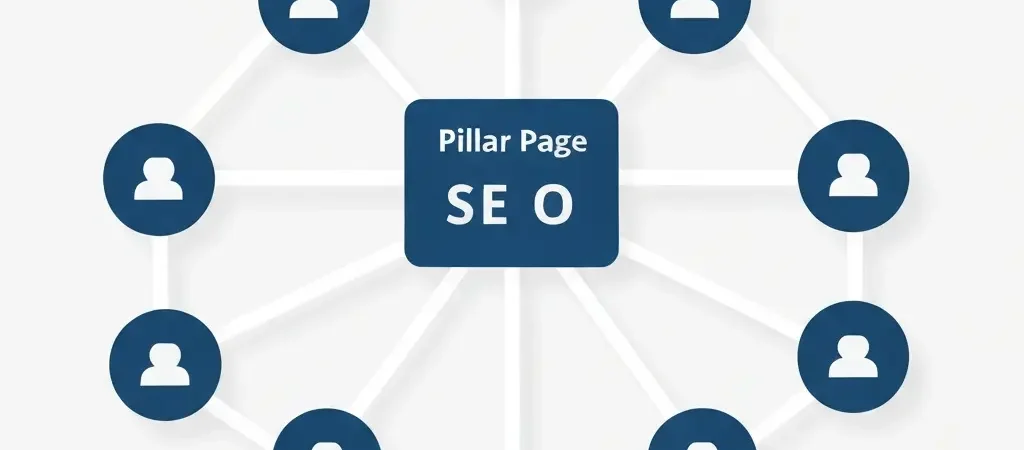
The pillar-cluster model is the proven content architecture for building topical authority. It works as follows:
The Pillar Page
A pillar page is a long-form, comprehensive piece of content — typically 2,500 to 5,000 words — that covers a broad topic at a high level. It is designed to rank for the primary head keyword and to serve as the hub of the topic cluster. A strong pillar page:
- Addresses the full scope of the topic without going too deep on any single subtopic
- Links to every cluster article in the network
- Earns backlinks as the canonical authority on the subject
- Updates regularly to stay current
Cluster Articles
Cluster articles are focused, medium-length pieces (1,000 to 2,000 words) that each address a specific subtopic or question within the broader subject. They:
- Target long-tail keywords related to the pillar topic
- Link back to the pillar page and to each other where contextually relevant
- Provide depth that the pillar page intentionally omits
Internal Linking Structure
The bidirectional linking between pillar and clusters is what concentrates topical authority. Every cluster article passing PageRank to the pillar strengthens it. The pillar distributing authority to clusters ensures they rank for their target queries. This is why automating SEO content creation is most effective when the system is built around a topic cluster architecture — not arbitrary keyword targeting.
| Content Type | Word Count | Keyword Target | Internal Links |
|---|---|---|---|
| Pillar Page | 2,500–5,000 | Head keyword (1k–50k/mo) | All cluster articles |
| Cluster Article | 1,000–2,000 | Long-tail (100–5k/mo) | Pillar + related clusters |
| Supporting Article | 800–1,200 | Micro-queries (<100/mo) | Nearest cluster article |
Why Topical Authority Beats Keyword Stuffing
Keyword stuffing — the practice of artificially repeating a target keyword to manipulate rankings — was a viable tactic in the early 2000s. Google’s algorithms have systematically devalued it over two decades of updates. In 2026, it is not just ineffective; it is actively penalized.
Here is why topical authority is structurally superior:
- Semantic understanding: Google’s natural language models (including the MUM and Gemini-era systems) understand concepts, not just keywords. A page that comprehensively covers a topic will rank for hundreds of related queries, including ones you never explicitly targeted.
- Compounding returns: Each new article you publish within an existing topic cluster adds to the authority of every other article in that cluster. Keyword stuffing generates no compounding effect — each page lives in isolation.
- Durability: Topical authority is built on genuine content depth. Algorithm updates tend to strengthen it. Keyword manipulation is fragile — a single core update can wipe out rankings built on it overnight.
- AI citation advantage: AI answer engines like Perplexity and ChatGPT actively prefer citing sources with strong topical authority. Sites built on keyword stuffing are structurally invisible to AI systems looking for comprehensive subject coverage.
According to Semrush’s research on topical authority, sites that invest in topic clusters see an average 55% increase in organic impressions within six months — compared to 12% for sites that continue targeting isolated keywords without cluster architecture.
What Google’s 2026 Core Update Changed
Google’s March 2026 Core Update specifically amplified E-E-A-T signals and accelerated the recognition of fresh topical clusters. Key changes that affect your topical authority strategy:
- Experience signals weighted higher: Content demonstrating first-hand experience — original data, case studies, author credentials — ranks measurably better than aggregated rewrites.
- Cluster freshness: Google now evaluates whether a topic cluster has been updated recently, not just published. Stale clusters — even ones with strong internal linking — see ranking degradation over time.
- AI-generated content policy clarified: Google explicitly confirmed it rewards high-quality content regardless of production method. The quality gate — accuracy, depth, E-E-A-T — is what matters, not the author being human.
- AI Overview citation threshold raised: Sites need demonstrably higher topical authority to appear in AI Overview responses. This has made building a complete cluster architecture a prerequisite for AI search visibility, not just traditional SERPs.
Understanding what AI content generation for SEO involves is essential context here — the update effectively rewards sites that use AI to build depth at scale, while penalizing those that use it to produce shallow, keyword-stuffed volume.
Topical Authority and AI Search Engines
The rise of AI answer engines — ChatGPT, Perplexity, Google AI Overviews, Bing Copilot — has made topical authority more valuable, not less. These systems are citation engines: they pull from sources they assess as authoritative on a given subject and surface them to users.
Sites with strong topical authority are cited disproportionately because:
- They cover the full subject graph, making them useful sources for a wider range of queries
- Their structured markup (FAQ, HowTo, Article schema) makes content easier for AI to parse and cite
- Their E-E-A-T signals align with the trust criteria AI systems use to select sources
- Their internal linking architecture helps crawlers build a complete picture of the site’s subject coverage
This intersection of topical authority and AI citation is what makes Answer Engine Optimization (AEO) inseparable from a modern SEO strategy. Topical authority is the foundation; AEO is the structural layer on top of it.
How to Build Topical Authority Systematically
Building topical authority is a systematic process, not a creative one. Here is the repeatable framework:
Step 1: Choose One Subject Domain
Do not try to build authority across multiple unrelated topics simultaneously. Pick one subject where you have genuine expertise or product-market fit and go deep before expanding. Breadth without depth is the fastest way to signal low topical authority.
Step 2: Map the Topic Cluster
Identify every meaningful question, angle, and subtopic within your chosen subject. Tools like Ahrefs’ content gap analysis, Semrush’s topic research, and Google’s People Also Ask feature are useful here. Your goal is to identify the full “topic graph” — every query a user might ask within your subject.
Step 3: Build the Pillar First
Publish your pillar page before any cluster articles. This establishes the hub that cluster articles will link back to. A pillar without clusters is weak; clusters without a pillar lose significant authority concentration.
Step 4: Publish Clusters Consistently
Consistency matters more than volume. Publishing 3 cluster articles per week is more effective than publishing 20 in one week and nothing for two months. Google’s crawl frequency rewards consistent publishing signals. This is where automating your SEO content creation pipeline delivers the most measurable ROI — it removes the human bottleneck from consistent cluster publishing.
Step 5: Interlink Aggressively
Every cluster article should link back to the pillar. Related cluster articles should link to each other. Supporting articles should link to the nearest cluster. Internal linking is the mechanism that concentrates authority — without it, you have a collection of isolated pages, not a topic cluster.
Step 6: Refresh and Expand
After your initial cluster is published, identify gaps — questions in your topic graph that are not yet covered — and publish supporting content. Refresh existing articles quarterly with updated data, new examples, and expanded sections. Cluster freshness is now a direct ranking signal.
How to Measure Topical Authority
No single metric perfectly captures topical authority, but these proxies give you a reliable picture:
- Topical Authority score (Semrush): Semrush’s Topical Authority metric measures how dominant a domain is for a given keyword category. Available in the Keyword Overview and Domain Overview tools.
- Keyword coverage depth (Ahrefs): Filter your Ahrefs site explorer by topic to see how many related keywords in a cluster your site ranks for. Expanding keyword coverage within a cluster is the most direct proxy for growing topical authority.
- Average position trends: Track average position for your target cluster over a 90-day window. Consistent improvement across the cluster — not just the pillar — indicates topical authority is taking hold.
- AI citation rate: Manually or programmatically check how often your site appears in Perplexity, ChatGPT, and Google AI Overviews for queries within your topic cluster. This is the forward-looking indicator of topical authority in the AI search era.
- Internal link depth: Audit your internal link structure to ensure every cluster article is within two links of the pillar. Orphaned cluster articles lose authority concentration.
Authenova’s content intelligence dashboard tracks keyword coverage depth, cluster completeness, and publishing cadence in a single view — giving you an actionable topical authority scorecard without switching between tools. See how Authenova builds topical authority at scale.
Frequently Asked Questions
What is topical authority in SEO?
Topical authority is Google’s assessment of how comprehensively and reliably a website covers a particular subject area. A site with high topical authority has published a dense, interlinked network of content that addresses a topic from every meaningful angle — signaling to Google that it is the best resource on that subject.
Why does topical authority matter more than domain authority in 2026?
Domain authority is a third-party metric based primarily on backlink volume. Topical authority is directly tied to how Google’s algorithms evaluate content relevance and depth. Sites with strong topical authority consistently outrank higher-DA competitors in their niche because Google rewards comprehensive subject coverage over raw link counts.
How does topical authority relate to E-E-A-T?
E-E-A-T (Experience, Expertise, Authoritativeness, Trustworthiness) is Google’s quality framework for evaluating content. Topical authority is the structural mechanism that demonstrates E-E-A-T at scale. When a site covers a topic comprehensively — with first-hand experience, expert depth, and consistent trustworthy sourcing — it signals all four E-E-A-T dimensions simultaneously.
What is a pillar-cluster model?
The pillar-cluster model is a content architecture where a long-form pillar page covers a broad topic comprehensively, and a network of cluster articles each cover specific subtopics in depth. Every cluster article links back to the pillar, and the pillar links out to all clusters. This bidirectional internal linking structure concentrates topical authority signals around the pillar page.
How many articles do I need to build topical authority?
Research from Ahrefs and Semrush suggests that 25 to 30 tightly interlinked articles within a single topic cluster is the threshold at which Google begins to recognize topical authority for a given subject. However, quality and topical completeness matter more than raw article count — each article must cover a distinct angle with genuine depth.
Does topical authority help with AI search engines like ChatGPT and Perplexity?
Yes. AI answer engines like ChatGPT, Perplexity, and Google AI Overviews draw on sources they assess as authoritative on a given subject. Sites with strong topical authority — dense subject coverage, clear E-E-A-T signals, structured markup — are cited significantly more often than lower-authority sources. This makes topical authority the foundation of AEO (Answer Engine Optimization) as well.
How long does it take to build topical authority?
Sites that publish consistently within a focused topic cluster typically see measurable ranking improvements within 60 to 90 days. The March 2026 Google Core Update accelerated recognition of fresh topical clusters, meaning sites that build authority quickly — using AI-assisted content at scale — can see gains up to 3x faster than those using traditional publishing cadences.
Can AI-generated content build topical authority?
Yes, if it meets Google’s quality standards. Google’s position is that it rewards high-quality content regardless of how it is produced. AI-generated content can build topical authority when it is accurate, well-structured, genuinely helpful, and augmented with first-hand experience and expert review. Platforms like Authenova are designed specifically to produce this type of content at scale.
What is the difference between topical authority and keyword stuffing?
Keyword stuffing means artificially repeating a target keyword to manipulate rankings. Topical authority means genuinely covering a subject so comprehensively that Google’s algorithms recognize your site as the definitive resource. One is a manipulation tactic penalized by Google; the other is a durable structural advantage that compounds over time.
How do I measure my site’s topical authority?
No single metric perfectly captures topical authority, but useful proxies include: topical authority score in Semrush, keyword coverage depth in Ahrefs, average position trends for topic clusters over time, and AI citation rate — how often your site appears in AI Overview and Perplexity answers for your target subject.
Build Topical Authority at Scale with Authenova
Authenova’s AI content platform is purpose-built for topical authority. Define your keyword clusters, set your publishing cadence, and Authenova handles article generation, internal linking, schema markup, and WordPress publishing — automatically. No bottlenecks. No manual workflow. Just a compounding topical authority engine.
Start your free trial at authenova.site — and build the first 30 articles in your topic cluster this week.