How to Create a Pillar-Cluster Content Strategy (2026 Step-by-Step)
If you want to know how to create a pillar-cluster content strategy that earns rankings, earns AI citations, and compounds organic traffic month after month, you are in the right place. The pillar-cluster model is no longer a cutting-edge experiment — it is the foundational architecture that separates sites dominating page one from those stuck on page four. Backlinko’s 2026 research on 50 B2B SaaS websites found that pillar-cluster architectures delivered 63% more keyword rankings within 90 days and a 41% AI citation rate compared to just 12% for sites without clustered architecture. The data is unambiguous.
HubSpot coined the pillar-cluster model in 2016 after Google’s algorithm shifted from matching individual keywords to understanding topical relationships. A decade later, the model has only grown more important. Google’s Helpful Content system and AI Overviews reward sites that demonstrate depth and coherence across an entire topic, not just a single well-optimised page. This guide gives you a 10-step process you can execute this week — with a worked example, a visual mapping guide, and automation tips for 2026.
What Is the Pillar-Cluster Model?
The pillar-cluster model is a content architecture that organises website pages into two tiers. The pillar page is a single, comprehensive guide targeting a broad head keyword — it introduces every major subtopic within a theme but does not exhaust any of them. The cluster articles are a collection of focused pieces, each targeting one long-tail keyword that branches from the pillar topic, going deep on a single subtopic.
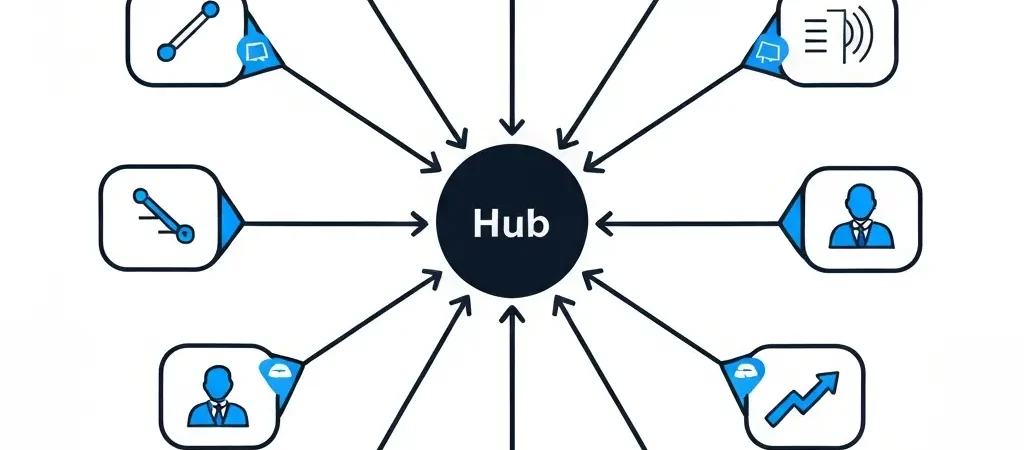
What makes the model work is the internal linking pattern. Every cluster article links back to the pillar, and the pillar links forward to every cluster. This bidirectional structure creates a self-reinforcing authority loop: Google sees that your site covers the full topical landscape, crawlers can reach every relevant page from a single hub, and PageRank flows efficiently through the entire content set.
For topical authority and AI-readiness, this architecture is now essential. To understand the deeper theory, see our guide on what topical authority is and why it matters in 2026.
Pillar vs. Cluster: Mapping Diagram
Visualise the architecture as a hub-and-spoke wheel:
                    [PILLAR PAGE]
              "Marketing Automation Guide"
                   (Head keyword)
                        |
        ┌───────────────┼───────────────┐
        |               |               |
  [CLUSTER 1]     [CLUSTER 2]     [CLUSTER 3]
 "What is email  "Marketing       "Best marketing
  automation"    automation       automation tools
                  workflows"      compared"
        |               |               |
  [CLUSTER 4]     [CLUSTER 5]     [CLUSTER 6]
 "Marketing       "CRM vs          "Marketing
  automation      marketing        automation for
  for SMBs"       automation"      ecommerce"
Each cluster node links up to the pillar. The pillar links down to every node. Supporting articles (a third tier) can branch from the most popular cluster articles for even deeper subtopics. This structure is what Ahrefs calls a “content hub” and what Google’s algorithms recognise as genuine topical expertise.
Step 1: Choose Your Core Topic
Start with a broad subject your business genuinely has authority to cover. The topic should:
- Have a head keyword with 2,000–10,000 monthly searches (enough to justify a pillar, not so narrow it cannot support 10+ clusters)
- Map directly to your product, service, or audience pain point
- Have clear subtopic branches — if you cannot list at least 8 obvious subtopics, the topic is too narrow
Good core topic examples: “content marketing,” “email marketing,” “project management,” “quit smoking,” “thesis writing.” Poor examples: “best email subject lines for Black Friday 2026” (too specific for a pillar) or “digital marketing” (too broad to own authoritatively).
Step 2: Validate Topical Demand
Before writing a single word, confirm the market exists at scale. Use Ahrefs’ Keywords Explorer or Google Search Console to answer three questions:
- Volume: Does the head keyword have consistent monthly search volume, not just a seasonal spike?
- Intent mix: Are searchers looking for information (informational intent) or to buy (commercial intent)? Both are valid but they shape how you write the pillar.
- Cluster potential: Enter the head keyword into Ahrefs and filter for question-based and long-tail variants. If you see 50+ related keywords with at least 100 searches/month each, you have a viable cluster.
Backlinko’s research shows that a well-executed content cluster can rank for over 29,000 keywords and attract more than 158,000 monthly visitors from a single hub. Volume validation ensures you are building toward that ceiling, not a dead end.
Step 3: Map the Pillar Page
The pillar page is a table of contents for the entire topic. Structure it as:
- Definition section: What is this topic? (target the head keyword here)
- Why it matters: Stakes, statistics, context
- Overview of subtopics: Brief introduction of each cluster theme with a link to the corresponding cluster article
- Core framework or process: The most important strategic overview
- FAQ and CTA
Target 2,000–4,000 words. The pillar should be the best single page on the internet about this topic at the overview level — comprehensive but not exhaustive on any individual subtopic. Depth on each subtopic lives in the cluster articles, not here.
Step 4: Research Cluster Keywords
Cluster keywords are the long-tail queries branching from your core topic. Use these research methods:
| Tool | Use For | Output |
|---|---|---|
| Ahrefs Keywords Explorer | Parent topic filtering, KD scores | Long-tail variants with volume + difficulty |
| AlsoAsked.com | Question-based cluster ideas | PAA tree — turns directly into article titles |
| Google Search Console | Discovering what your site already ranks for | Cluster gaps from existing impressions data |
| SEMrush Topic Research | Subtopic card view | Grouped subtopic clusters ready to assign |
Aim for 8–15 cluster keywords per pillar. Each should have at least 100 monthly searches and a clearly distinct search intent from the pillar and from each other.
Step 5: Assign Cluster Articles (No Intent Overlap)
The most common mistake in pillar-cluster execution is keyword cannibalization — assigning two cluster articles to keywords with identical or near-identical search intent. Google will split your ranking signal between both pages and neither will fully rank.
Before assigning a cluster keyword to an article, open Google and search for it. Look at the top three results. If those results are nearly identical to the results for another keyword you have already assigned, the two keywords share intent and should be merged into a single article.
A clean intent map looks like this:
- Pillar: “marketing automation” (broad informational)
- Cluster A: “what is marketing automation” (definitional — distinct)
- Cluster B: “marketing automation tools compared” (commercial — distinct)
- Cluster C: “marketing automation workflows examples” (procedural — distinct)
- NOT a valid cluster: “marketing automation software” when Cluster B already targets tools comparison (same SERP)
Step 6: Build the Internal Link Architecture
Internal linking is the mechanism that makes the pillar-cluster model work technically. Bidirectional links between pillar and clusters multiply AI citation probability by 2.7x according to the Yext AI Citation Study — meaning your content is significantly more likely to be surfaced in AI Overviews and chatbot answers when the link architecture is tight.
Rules for pillar-cluster internal linking:
- Every cluster article must include at least one contextual link back to the pillar page, with anchor text containing the pillar’s focus keyword
- The pillar page must link to every cluster article from a relevant section — not just a sidebar list
- Cluster articles should cross-link to adjacent clusters when relevant (e.g., Cluster B “tools compared” linking to Cluster C “workflow examples”)
- Avoid generic anchors like “click here” or “learn more” — use descriptive, keyword-rich anchor text
For a deeper dive into the mechanics, read our full guide on how to build topical authority with AI content.
Step 7: Write and Publish the Pillar First
Always publish the pillar page before any cluster articles. When cluster articles go live and link to the pillar, those links must point to a live URL — a 404 on the pillar wastes the link equity from every cluster article published before it. Publishing order matters for crawl efficiency and PageRank flow.
After publishing the pillar, submit it to Google Search Console for indexing before publishing clusters. This ensures Google crawls the hub URL first and can follow the outbound cluster links on first discovery.
Step 8: Publish Cluster Articles Consistently
Publishing cadence is an underrated signal. Sites that publish 2–4 cluster articles per week around a single pillar topic show consistent topical momentum — Google’s crawl budget allocation and freshness signals both respond to this. Do not publish all 12 cluster articles in a single day and go silent; spread them over 4–6 weeks.
HubSpot’s data shows that topic clusters built around pillar pages drive 30–43% more organic traffic than unconnected content. A consistent publishing schedule amplifies this effect by maintaining crawl recency signals throughout the cluster build-out phase.
To learn how to build and automate that schedule, see how to automate SEO content creation step by step.
Step 9: Add Supporting Content for Deep Subtopics
Some cluster articles will start ranking for multiple long-tail variants with distinct enough intent to warrant their own page. These become supporting articles — a third tier branching from a cluster, not directly from the pillar.
Trigger a supporting article when:
- A cluster article ranks position 5–15 for a high-volume long-tail variant with meaningfully different intent
- A subtopic within a cluster article is consistently expanding in word count — a sign it wants to be its own page
- A People Also Ask question from a cluster keyword has 500+ monthly searches and is not fully answered on the existing cluster page
Supporting articles link up to their parent cluster article, and the cluster article links down to them. The pillar itself does not need to link to supporting articles directly — the authority flows through the cluster layer.
Step 10: Audit and Expand Every 90 Days
A pillar-cluster strategy is not a set-and-forget system. Quarterly audits keep the architecture performing:
- Check for cannibalization: Use Ahrefs’ Site Explorer to see if two cluster articles are splitting ranking for the same keyword. If so, merge the weaker into the stronger.
- Identify thin clusters: Cluster articles under 800 words with no external backlinks rarely rank. Expand them to 1,200+ words or consolidate them into the pillar.
- Update statistics and data: Any article citing statistics should be refreshed annually. Outdated data is a Helpful Content signal penalty risk.
- Expand to new sub-clusters: After 90 days, check what new PAA questions and long-tail queries have emerged around your pillar topic. Add a second wave of cluster articles targeting those gaps.
- Monitor AI citation performance: Track whether your pillar and clusters are being cited in Google AI Overviews. Pillar-cluster sites achieve 41% AI citation rates — if you are below 20%, your internal link architecture or content depth needs work.
Worked Example: “Marketing Automation” Cluster
Here is exactly how a pillar-cluster strategy looks in practice for the topic “marketing automation,” which has approximately 90,000 monthly searches globally.
| Type | Title / Target Keyword | Vol/mo | Intent |
|---|---|---|---|
| PILLAR | The Complete Guide to Marketing Automation | 90,000 | Informational |
| Cluster 1 | What is marketing automation? | 12,000 | Definitional |
| Cluster 2 | Best marketing automation tools compared 2026 | 8,500 | Commercial |
| Cluster 3 | Marketing automation workflow examples | 4,400 | Procedural |
| Cluster 4 | Marketing automation for small business | 3,200 | Segment-specific |
| Cluster 5 | CRM vs marketing automation: what’s the difference? | 2,900 | Comparative |
| Cluster 6 | How to set up email marketing automation | 2,400 | How-To |
| Cluster 7 | Marketing automation ROI statistics | 1,800 | Data/Research |
| Cluster 8 | Marketing automation for ecommerce | 1,600 | Segment-specific |
Each of those 8 cluster articles links back to the pillar with anchor text like “complete guide to marketing automation.” The pillar introduces each subtopic in a dedicated section and links forward to the corresponding cluster. Total potential keyword coverage from this single cluster: 1,000+ long-tail variations, based on Minuttia’s cluster analysis methodology.
How to Automate a Pillar-Cluster Strategy
Manual execution of a 10-article pillar-cluster takes weeks of writing, editing, and interlinking. In 2026, the most competitive content programs automate this process entirely. Authenova’s platform lets you:
- Define your pillar and cluster keywords in a strategy with assigned roles (PILLAR, CLUSTER, SUPPORTING)
- Set a publishing schedule that automatically spaces cluster articles over 4–6 weeks
- Auto-generate internal links based on your content map so every cluster article links to the pillar on publication
- Push published articles directly to WordPress without manual copy-paste
This compresses a 6-week manual cluster build into an automated pipeline that executes itself. See the step-by-step SEO content automation guide for the full workflow, and explore how to build topical authority with AI for the strategic layer above the cluster level.
Ready to Build Your First Cluster?
Authenova automates the entire pillar-cluster workflow — keyword mapping, article generation, internal linking, and WordPress publishing — so your content architecture executes on autopilot.
Frequently Asked Questions
What is a pillar-cluster content strategy?
A pillar-cluster content strategy organises website content around one comprehensive pillar page on a broad topic, supported by multiple cluster articles that cover related subtopics in depth. Every cluster links back to the pillar, and the pillar links out to each cluster, creating a tight internal link architecture that signals topical authority to search engines.
How many cluster articles do I need per pillar?
Most SEO practitioners recommend 8–15 cluster articles per pillar page. HubSpot’s original 2016 research suggested a minimum of 8 clusters to see meaningful authority consolidation. For competitive topics, 12–20 cluster articles can accelerate the topical authority signal.
Does the pillar-cluster model still work in 2026?
Yes — and it works better than ever. Backlinko’s 2026 research on 50 B2B SaaS sites found pillar-cluster architectures achieved 63% more keyword rankings within 90 days and 41% AI citation rates versus 12% for unstructured sites. Google’s Helpful Content system and AI Overview models both reward topical depth and entity coherence, which is exactly what pillar-cluster architecture delivers.
Should I publish the pillar or cluster articles first?
Publish the pillar page first. This ensures that every internal link from cluster articles points to a live URL from the moment of publication, maximising the PageRank flow and avoiding 404 internal links during the crawl cycle.
How is a pillar page different from a cluster article?
A pillar page is a long-form, comprehensive guide (2,000–4,000 words) targeting a broad, high-volume keyword. It introduces every subtopic without exhausting it. A cluster article is a focused, deep-dive piece (1,000–2,000 words) targeting one specific long-tail keyword that branches from the pillar’s core topic.
Can I automate a pillar-cluster strategy?
Yes. Platforms like Authenova let you define your pillar and cluster keywords, assign them to a strategy, and automate article generation, internal linking, and publishing on a schedule. This allows teams to execute a 15-article cluster at a consistent publishing cadence without manual effort at the article level.