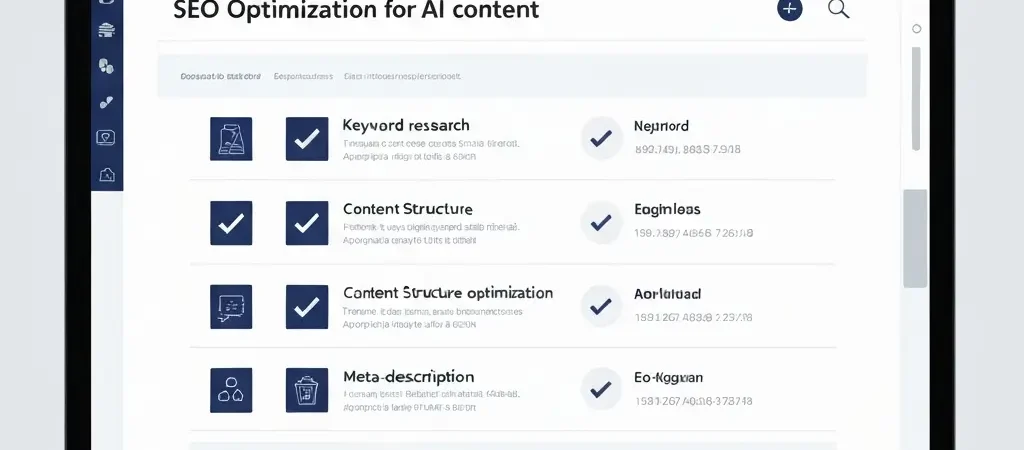
How to Optimize AI Content for Search Engines (2026 Checklist)
Learning how to optimize AI content for search engines is now a core SEO skill. AI writing tools can produce 1,500 words in under a minute — but raw AI output rarely ranks without deliberate optimization. Google’s Helpful Content system evaluates quality signals that AI alone does not automatically satisfy: E-E-A-T, topical depth, unique perspective, and structured data. This checklist walks through every step you need to turn a generated draft into a ranking asset in 2026.
The gap between AI content that ranks and AI content that sits at position 60 comes down to process, not the model used. Sites applying a consistent optimization workflow after generation are seeing 3-4x higher ranking rates than those publishing raw output, according to internal data from automated content platforms. The steps below close that gap systematically.
1. Keyword Mapping and Intent Alignment
Before editing a word of the AI draft, confirm that the content matches the search intent behind your target keyword. Google classifies intent as informational, navigational, commercial, or transactional — and the top 10 results for any query almost always share the same intent type.
Run these checks against your draft:
- Primary keyword in the H1 and first 100 words. AI drafts sometimes bury the focus term or rephrase it in a way that weakens the signal.
- Keyword density of 1–2%. Over-repetition triggers spam signals; under-use weakens relevance. For a 1,200-word article targeting “how to optimize AI content for search engines,” the phrase should appear 12–24 times in natural variants.
- Semantic terms present. Use a tool like Surfer SEO or Frase to check that NLP-related terms (entities, synonyms, co-occurring concepts) appear throughout. AI drafts often miss niche entities specific to your industry.
- Meta title under 60 characters, meta description under 160 characters. AI tools frequently generate over-length metadata. Trim it manually.
2. Heading Structure That Matches Search Intent
Heading structure is both a crawlability signal and a UX signal. Google uses headings to understand content hierarchy and surface relevant passages in featured snippets and SGE answers.
Checklist for heading optimization:
- One H1 only — include the focus keyword.
- H2s should map to the distinct sub-questions users have about the topic. Check “People Also Ask” and related searches for the target keyword to identify these.
- H3s break down individual H2 sections — use them for step-by-step items, sub-categories, or examples.
- Avoid consecutive H2s with no body text between them. Google’s quality guidelines flag thin sections.
- Include the focus keyword or a close variant in at least one H2.
AI models tend to generate generic heading structures. Rewrite H2s to match the exact phrasing users search for. A heading like “Benefits of AI Content” becomes more rankable as “What AI Content Can Do for Your SEO in 2026” — it captures a longer-tail variant and signals recency.
3. Internal Linking for Topical Authority
Internal links are how you build topical authority across a content cluster. A standalone AI-generated article with no internal links is an island — it cannot benefit from or contribute to the authority of related pages.
For every AI article you publish:
- Add 3–6 contextual internal links to related content on the same site.
- Use descriptive anchor text that includes keywords from the linked page — not “click here” or “read more.”
- Link to pillar pages that cover broader versions of the topic.
- Link to supporting articles that go deeper on sub-topics.
For this article, relevant internal links include: whether AI content is good for SEO, how to automate SEO content creation, how to scale content production, producing AI blog posts that rank, and tracking SEO performance of AI content. This linking pattern signals to Google that your site has depth on the AI content topic.
4. Schema Markup for Rich Results
Schema markup is one of the most underused optimization levers for AI content. Adding structured data does not directly boost rankings, but it improves your click-through rate by enabling rich results — which effectively increases organic traffic from the same position.
Apply these schema types based on content format:
- Article schema — every blog post should have this at minimum. Include author, datePublished, dateModified, and headline.
- FAQPage schema — add to any article with a FAQ section. Each Q&A becomes eligible for display in Google’s PAA (People Also Ask) box.
- HowTo schema — for step-by-step guides, this markup can trigger a rich result showing numbered steps directly in SERPs.
- BreadcrumbList schema — helps Google understand your site hierarchy and displays cleaner URLs in SERPs.
AI tools rarely generate schema automatically. Platforms like Authenova handle schema generation as part of the content pipeline — a significant time saving at scale.
5. E-E-A-T Signals and Credibility Layers
Experience, Expertise, Authoritativeness, and Trustworthiness (E-E-A-T) is the framework Google’s quality raters use to evaluate content. AI drafts score poorly on Experience by default because they cannot reference first-hand use, direct testing, or personal outcomes.
Add E-E-A-T signals manually after generation:
- Experience signals: Add a sentence or paragraph from the perspective of someone who has actually implemented the advice — real outcomes, real numbers, specific tool versions tested.
- Expertise signals: Include author bio with verifiable credentials. Link to the author’s LinkedIn or professional profile.
- Authority signals: Cite authoritative external sources (Google Search Central, peer-reviewed research, industry studies). Add 2–4 outbound links to credible sources.
- Trust signals: Ensure the page has a clear publication date, last-updated date, and a named human author. Anonymous AI content is a red flag for quality raters.
6. Unique Angles and Original Perspective
Google’s Helpful Content guidance specifically asks whether content says “something new or interesting” versus simply repeating what is already indexed. AI models are trained on existing content, which means their default output tends to be a statistical average of what already ranks — not something original.
Inject uniqueness through:
- Original data. Even simple data — your own site’s ranking rates, client results, internal benchmarks — creates content that cannot be replicated by competitors running the same AI prompt.
- Contrarian takes. Identify one claim in the AI draft that the consensus is wrong about, and argue the opposite with evidence.
- Specific examples. Replace generic AI examples (“Company X increased traffic by implementing AI content”) with real, named case studies with verifiable sources.
- Current-year context. Add details about 2026-specific developments: algorithm updates, new tool features, recent research. AI training data has a cutoff; its sense of “current” is always stale.
7. Facts, Statistics, and Citations
AI models hallucinate statistics. This is a well-documented failure mode — models confidently generate plausible-sounding numbers that have no basis in reality. Publishing hallucinated statistics damages E-E-A-T and creates legal liability if the content is used in commercial contexts.
Fact-checking protocol for AI content:
- Flag every statistic, percentage, and named study in the AI draft.
- Verify each one against the primary source — not another article that cites the same number.
- Replace unverifiable statistics with real data from Google Search Central Blog, Search Engine Journal, Ahrefs, Semrush, or peer-reviewed journals.
- Add the year of the statistic. A 2022 stat about AI content behavior is not valid in a 2026 context.
- Link to the primary source directly. This is both a trust signal and a good editorial practice.
According to Google Search Central’s guidance on helpful content, pages that cite verifiable sources are more likely to be rated as high-quality by human evaluators.
8. The Human Editorial Pass
The human editorial pass is not optional. It is the step that transforms AI output into content that meets Google’s definition of “written for people.” This does not mean rewriting the entire article — it means applying targeted improvements to the sections where AI falls short.
Structured editorial pass (30–45 minutes for a 1,500-word article):
- Read the full draft aloud. Identify any sentence that sounds unnatural, robotic, or repetitive. Rewrite those sentences.
- Cut filler transitions. AI models overuse phrases like “in today’s fast-paced world,” “it’s important to note,” and “in conclusion.” Delete or replace them.
- Add one specific, personal example per major section. Even a hypothetical grounded in real tool behavior works better than a generic AI example.
- Strengthen the intro. AI intros are often weak — they restate the title rather than hooking the reader. Rewrite the first two paragraphs to open with a pain point or provocative question.
- Tighten the CTA. AI-generated calls to action are generic. Customize the CTA to the specific audience and product.
9. AI Detection and Quality Audit
Running your content through an AI detection tool before publishing is a quality gate, not a censorship exercise. Tools like Originality.ai, Copyleaks, and Winston AI score content on the probability that it was AI-generated. High scores on these tools correlate with content that reads as generic and low-E-E-A-T — which is the editorial problem to fix, not the detection score itself.
Detection audit workflow:
- Run the draft through Originality.ai (industry standard for SEO content).
- Identify the specific paragraphs flagged as high-probability AI. These are the sections that need the most editorial work.
- Rewrite flagged sections to include specific examples, personal voice, or first-hand perspective.
- Re-run to confirm improvement.
- Target: no more than 20% AI probability score on the final published version.
A platform like Authenova builds quality gates — including schema generation, keyword density checks, and internal link scaffolding — directly into the content pipeline, reducing the manual audit burden significantly. If you are running AI content at scale, automating these checks is the only way to maintain consistent quality without proportionally increasing editorial headcount.
Ready to Automate Your AI Content Optimization?
Authenova handles keyword mapping, schema markup, internal linking, and WordPress publishing automatically — so your editorial team spends time on what only humans can do. See how Authenova works.
FAQ
Does Google penalize AI-generated content in 2026?
Google does not penalize content for being AI-generated. It penalizes content that is low-quality, unhelpful, or manipulative — regardless of how it was produced. AI content that passes through a proper optimization and editorial process ranks the same as human-written content of equivalent quality. The risk is publishing raw, unoptimized AI output that lacks E-E-A-T signals and unique perspective.
How long does AI content take to rank?
Properly optimized AI content typically enters the index within 1–7 days and begins ranking within 4–12 weeks for low-to-medium competition keywords. Higher-competition terms take 3–6 months. The ranking timeline for optimized AI content is not meaningfully different from human-written content — both depend on domain authority, backlinks, and content quality.
What is the most important optimization step for AI content?
E-E-A-T layering is the most important single step. Google’s quality rater guidelines specifically evaluate experience and expertise signals, and AI models cannot generate these authentically. Adding first-hand experience, named authorship, verified statistics, and credible outbound citations addresses the biggest gap between raw AI output and rankable content.
Should I disclose that content is AI-generated?
Google does not require disclosure of AI-generated content. However, adding a named human author and editor — even when AI wrote the draft — is best practice for E-E-A-T. Some industries (legal, medical, financial) have regulatory considerations around automated content that are separate from Google’s guidelines. Always check applicable regulations for your specific sector.
How do I scale AI content optimization without hiring more editors?
The answer is automating the repeatable checks — keyword density, schema markup, internal linking, metadata length — and reserving human editorial time for the steps that require judgment: E-E-A-T layering, unique angles, and fact verification. Platforms like Authenova automate the systematic quality gates, reducing editorial time per article to 20–30 minutes while maintaining ranking-grade quality at scale.