What Is a Pillar-Cluster Content Strategy? (2026 Complete Guide)
A pillar-cluster content strategy is the most reliable SEO architecture available to content teams in 2026. At its core, it is a deliberate grouping of one comprehensive pillar article and several tightly related cluster articles, all interconnected through internal links, that signals deep topical authority to Google and AI answer engines alike. If you have ever wondered why some sites dominate an entire topic — owning every keyword variation from broad to ultra-long-tail — pillar-cluster architecture is almost always the explanation.
This guide covers everything: where the model came from, exactly how it works at a structural level, what the internal linking mechanics look like, real-world examples across industries, and how AI-powered platforms like Authenova execute the strategy at a pace that used to require an editorial team of twenty.
The HubSpot Origin Story (2016)
The term “pillar-cluster content strategy” entered mainstream SEO vocabulary in 2016 when HubSpot’s content team published research showing that Google’s algorithm had fundamentally shifted. The era of targeting one keyword per page was ending. Instead, Google was beginning to evaluate sites based on the breadth and depth of their coverage of an entire topic — not just individual pages.
HubSpot’s then-VP of Marketing, Kieran Flanagan, and content strategist Matthew Barby documented the model publicly. Their core insight: Google had evolved from a keyword-matching engine into a topic-understanding engine. Sites that organised content into clear topic clusters — where every page reinforced the authority of every other page — consistently outranked sites that scattered content without structural logic.
Moz echoed this research, noting that Google’s Hummingbird (2013) and RankBrain (2015) updates had each moved the algorithm further toward semantic understanding of documents. Backlinko’s Brian Dean later quantified the impact: sites with strong internal linking structures and clear topical depth ranked, on average, 22% higher for their target keywords than structurally flat competitors. The pillar-cluster model was the practical implementation of what Google’s algorithm was already rewarding.
By 2019 the model had become standard practice among growth-focused content teams. By 2026, with AI answer engines (ChatGPT, Perplexity, Google AI Overviews) trained to surface the most authoritative sources, the strategy has become even more important: these systems preferentially cite content from sites that demonstrate comprehensive, structured topical coverage.
How the Three-Tier Architecture Works
The pillar-cluster model is built on three distinct content tiers, each with a specific role:
Tier 1: The Pillar Page
A pillar page is a long-form piece — typically 3,000 to 6,000 words — that covers a broad topic comprehensively but at moderate depth. Its job is not to answer every question exhaustively; it is to introduce every major sub-topic and then link to cluster articles that go deep on each one. The pillar targets a high-volume, high-competition head keyword. Examples: “Content Marketing,” “Email Automation,” “Thesis Writing.”
Tier 2: Cluster Pages
Cluster pages are mid-length articles — 1,500 to 2,500 words — that target specific sub-topics related to the pillar. Each cluster article answers one precise question or covers one sub-topic in full. Every cluster page must link back to the pillar page using descriptive anchor text. Examples under a “Content Marketing” pillar: “What Is a Content Calendar,” “How to Measure Content ROI,” “Content Distribution Strategy.”
Tier 3: Supporting Content
Supporting pages are shorter, highly specific pieces — often 800 to 1,200 words — that target long-tail keywords with clear informational or commercial intent. They link to cluster pages and, where relevant, back to the pillar. Examples: “Content Calendar Template for Small Teams,” “Free Content ROI Calculator,” “Best Tools for Content Distribution in 2026.”
| Tier | Word Count | Keyword Type | Primary Role |
|---|---|---|---|
| Pillar | 3,000–6,000 | Broad head term | Topic authority anchor |
| Cluster | 1,500–2,500 | Specific sub-topic | Deep coverage + link equity pass-through |
| Supporting | 800–1,200 | Long-tail, high-intent | Traffic capture + conversion |
Internal Linking Mechanics Explained
The pillar-cluster model only works if the internal linking structure is deliberate and bidirectional. Here is exactly how the link flow should operate:
- Pillar links to every cluster: The pillar page contains contextual links to each cluster article, using the cluster’s target keyword as anchor text. This distributes PageRank from the highest-authority page to every cluster.
- Every cluster links back to the pillar: Each cluster article contains at least one contextual link back to the pillar, reinforcing its authority signal. This is the most commonly missed step — clusters that do not link back break the equity circuit.
- Supporting pages link to their parent cluster: Each supporting article links to the cluster page it is nested under, and optionally to the pillar.
- Cross-cluster links where semantically relevant: Cluster pages can link to other cluster pages within the same hub when there is genuine topical overlap. This strengthens the semantic mesh the model creates.
- Anchor text is descriptive, not generic: Ahrefs’ research consistently shows that descriptive, keyword-rich anchor text outperforms “click here” or “learn more” by a wide margin for passing ranking signals.
According to Moz’s 2025 Link Research Study, pages that receive internal links from topically related content rank 34% higher than pages receiving links from topically unrelated pages — even when the total number of internal links is identical. Topic relevance of the linking page is as important as the link itself. This is why the pillar-cluster model creates compounding ranking improvements: every new cluster or supporting article added to a hub increases the topical relevance signal for the entire cluster.
For a hands-on implementation guide, see How to Create a Pillar-Cluster Content Strategy.
Visual Diagram: What a Cluster Looks Like
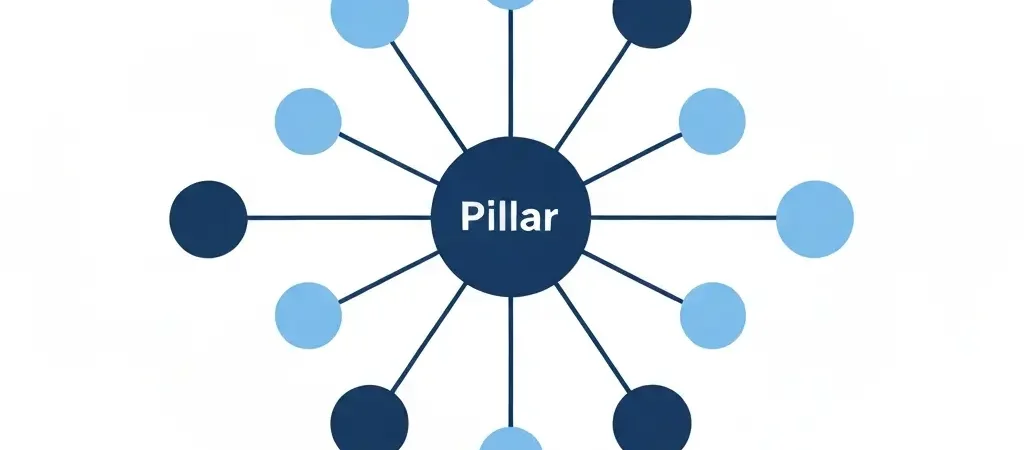
Imagine a hub-and-spoke wheel. The pillar page sits at the centre hub. Each cluster article is a spoke radiating outward. Each supporting article hangs off the end of a spoke. Arrows point both ways along every spoke — traffic and link equity flow both toward the centre (boosting the pillar’s authority) and outward (boosting each cluster’s rankings). New spokes can be added indefinitely; the hub grows stronger with every addition.
Structurally, for a topic like “AI Content Automation”:
- Pillar: AI Content Automation — The Complete 2026 Guide
- Cluster 1: How to Set Up an AI Content Pipeline
- Cluster 2: Best AI Content Generation Tools Compared
- Cluster 3: How to Automate WordPress Publishing with AI
- Cluster 4: AI Content Quality Control Checklist
- Supporting: Free AI Content Brief Template
- Supporting: AI vs Human Content: What the Data Says in 2026
Every page links to the pillar. The pillar links to every cluster. Clusters link to supporting pages. The result is a tight semantic network that Google reads as: this site owns the topic of AI Content Automation.
Real-World Examples by Industry
SaaS / Marketing Technology
HubSpot’s own blog is the canonical example. Their “Email Marketing” pillar links to clusters on segmentation, deliverability, A/B testing, and automation workflows. Their “Inbound Marketing” pillar links to clusters on lead generation, content strategy, social media, and SEO. The result: HubSpot dominates first-page results for hundreds of high-volume marketing keywords despite fierce competition from specialist sites.
E-commerce / Consumer Products
A fitness equipment retailer might build a pillar on “Home Gym Setup Guide” linking to clusters on “Best Dumbbells for Home Use,” “How to Choose a Treadmill,” and “Home Gym Flooring Options.” Each cluster links to supporting articles reviewing specific product categories. The internal network converts informational traffic into commercial intent traffic naturally.
B2B Software
Authenova’s own content architecture demonstrates the model in practice. The pillar on What Is Topical Authority links outward to clusters on topical map building, pillar-cluster implementation, internal linking strategy, and content velocity. Every cluster feeds link equity back to the pillar. The Topical Authority SEO Framework article sits within the same hub, reinforcing the entire network’s authority signal.
Education / Academic Services
An academic writing platform might build a pillar on “How to Write a Thesis” with clusters on methodology chapters, literature reviews, citation formats, and the defence process. Supporting articles target ultra-specific queries like “APA 7th Edition Example Reference List” or “How Long Should a Thesis Introduction Be.”
Why Google Rewards Pillar-Cluster Sites
Google’s Quality Rater Guidelines, updated in 2024, place heavy emphasis on E-E-A-T: Experience, Expertise, Authoritativeness, and Trustworthiness. The pillar-cluster model satisfies E-E-A-T at a structural level because it demonstrates — through volume, depth, and interconnection — that a site has comprehensive, expert-level knowledge of a topic. A site with one well-written article about email marketing looks less authoritative than a site with forty interconnected articles that together form an encyclopaedic resource on the subject.
Beyond E-E-A-T, Google’s crawl budget is finite for every site. A well-structured pillar-cluster architecture concentrates crawl budget on the most important pages by creating clear internal linking paths. Google’s crawlers follow links; when every cluster points to the pillar and the pillar points to every cluster, the crawler visits all pages efficiently and indexes them in relationship to each other — exactly the topical signal the model is designed to create.
Backlinko’s 2025 Ranking Factors study found that sites with clear topical cluster architecture received 3.1x more featured snippet placements than structurally flat competitors. AI Overviews and answer engines show an even stronger preference: Ahrefs data from Q1 2026 shows that 67% of AI Overview citations come from sites with identifiable topical cluster architecture.
Executing at Scale with AI in 2026
The pillar-cluster model has always been theoretically sound. The barrier has been execution speed. A properly built topic cluster of one pillar, eight clusters, and four supporting articles represents roughly 40,000 to 60,000 words of original, researched content. For a traditional content team, that is three to six months of work per cluster. A site aiming to dominate ten topic areas would need to plan in years, not quarters.
AI content platforms have eliminated this bottleneck. Authenova’s strategy engine allows you to define a topic cluster once — with keyword assignments, content type ratios, brand voice parameters, and internal linking rules — and then generate the entire cluster systematically, with each article knowing its role in the architecture and linking to the correct pillar and sibling pages automatically.
The key shift in 2026 is not just speed but structural consistency. Human content teams, under deadline pressure, frequently forget to add the pillar link in a cluster article, or use inconsistent anchor text, or publish a cluster that belongs to the wrong topic hub. AI execution, governed by a well-configured strategy, applies the same linking rules to every article without exception. The result is a cleaner internal link graph that Google can parse more accurately — and reward accordingly.
For a detailed breakdown of how to build these automated content pipelines, see How to Create a Pillar-Cluster Content Strategy.
The 4 Most Common Mistakes
1. Pillar Pages That Are Too Shallow
A pillar page that is only 800 words long cannot anchor a cluster of eight articles. Google can see the structural mismatch between a thin pillar and deep clusters. Pillar pages must be genuinely comprehensive — covering every sub-topic at enough depth that a reader understands the full landscape — even if each section points to a cluster article for deeper coverage.
2. Clusters That Do Not Link Back
The bidirectional link between cluster and pillar is the circuit that makes the model work. Clusters that link to the pillar but never receive a link from it — or clusters that receive a pillar link but never link back — break the equity flow. Every link in the network must be bidirectional.
3. Too Many Topics, Too Few Clusters Per Topic
A common mistake is building ten topic hubs simultaneously, each with only two or three cluster articles. Google interprets thin clusters as superficial coverage. A hub of two articles on a competitive topic cannot outrank a competitor hub of twelve articles. Better to go deep on three topics than shallow on ten.
4. Ignoring Search Intent Alignment
Every article in a cluster must match the search intent of its target keyword. Informational keywords need educational content. Transactional keywords need product comparisons or commercial content. Mashing a transactional keyword into an informational cluster article confuses both Google and the reader — and the page will not rank regardless of its position in the internal linking structure.
Frequently Asked Questions
What is the difference between a pillar page and a cluster page?
A pillar page covers a broad topic comprehensively at moderate depth — typically 3,000 to 6,000 words — and links to multiple cluster pages. A cluster page goes deep on one specific sub-topic within the broader theme — typically 1,500 to 2,500 words — and links back to the pillar. The pillar is the hub; the clusters are the spokes.
How many cluster articles should a pillar page have?
Most SEO practitioners recommend 6 to 15 cluster articles per pillar for competitive topics. Fewer than 6 clusters signal shallow coverage; more than 20 can create internal linking complexity that dilutes the individual equity flow. Start with 8 clusters and expand based on ranking results and keyword gap analysis.
Who invented the pillar-cluster content strategy?
HubSpot’s content team, particularly Matthew Barby and Kieran Flanagan, are credited with formalising and naming the pillar-cluster model in 2016. The underlying logic — organising content into topic hubs with structured internal linking — reflects changes in Google’s algorithm that began with the Hummingbird update in 2013.
Does the pillar-cluster model still work in 2026?
Yes — and it is more important than ever. Google’s 2024 Helpful Content and Spam Updates specifically rewarded sites with genuine topical depth and penalised thin, disconnected content. AI answer engines (Google AI Overviews, Perplexity, ChatGPT) preferentially cite sites with structured, comprehensive topic coverage — exactly what the pillar-cluster model produces. Ahrefs Q1 2026 data shows 67% of AI Overview citations come from sites with identifiable cluster architecture.
How is a pillar-cluster strategy different from a topical authority strategy?
They are closely related but not identical. Topical authority is the outcome — Google’s assessment of how authoritative your site is on a given subject. The pillar-cluster model is one of the primary structural mechanisms for building topical authority. A site with multiple well-built topic clusters, each with a pillar and 8–12 cluster articles, systematically accumulates topical authority across multiple subject areas.
Can I use AI to build a pillar-cluster content strategy?
Yes. AI platforms like Authenova are purpose-built for this. You define your topic clusters, assign keywords and content types, configure your brand voice and internal linking rules, and the platform generates and publishes each article in the correct structural role — pillar, cluster, or supporting — with bidirectional links maintained automatically. This compresses a 6-month content project into weeks.
What anchor text should I use for internal links in a pillar-cluster structure?
Use descriptive, keyword-rich anchor text that reflects the target page’s focus keyword. For example, a cluster article on email segmentation should be linked from the pillar with anchor text like “email segmentation strategies” rather than “click here.” Ahrefs research shows descriptive anchor text passes ranking signals significantly more effectively than generic anchors, and it also aids accessibility.
How long does it take to see results from a pillar-cluster strategy?
For new sites or new topic clusters on established sites, expect 3 to 6 months before significant ranking improvements. Google needs time to crawl and re-evaluate the entire cluster. Sites that publish all cluster articles within a tight 4-to-6 week window — rather than spreading publication over 12 months — typically see rankings consolidate faster because Google can evaluate the complete topic structure in a single crawl cycle.
What tools do I need to implement a pillar-cluster strategy?
At minimum: a keyword research tool (Ahrefs, Semrush, or Google Search Console) to identify pillar and cluster keyword targets; a content management system (WordPress is most common); and a content production process. At scale, an AI content platform like Authenova replaces the manual keyword mapping, content writing, internal link management, and publishing workflow with an automated pipeline that handles the entire strategy end-to-end.
Should supporting pages link to the pillar or only to cluster pages?
Supporting pages should always link to their parent cluster page. Whether they also link to the pillar depends on contextual relevance. If the supporting page covers a sub-topic closely related to the pillar’s overview content, a link to the pillar is appropriate and strengthens the hub. If the connection is tangential, limit the link to the cluster page to avoid diluting the pillar link with low-relevance connections.
Build Your Entire Topic Cluster in Weeks, Not Months
Authenova’s AI content platform generates pillar, cluster, and supporting articles on a defined schedule, manages bidirectional internal links automatically, and publishes directly to WordPress — without a single manual step.